Classification is a supervised learning task that predicts a discrete class from an instance’s features. Given historical pairs D = {(xᵢ, yᵢ)}, a model learns a function f that maps x to a predicted category y. section 4.1
A classification workflow typically involves:
- Representing each instance with features such as an image or other measured variables, alongside a categorical outcome. section 4.1
- Choosing a function family, such as a linear model, decision tree, random forest, boosted tree, k-nearest neighbors, or deep learning model. section 4.1
- Fitting the model to historical data so its predictions match observed classes as closely as the chosen objective requires. section 4.1
- For binary outcomes, interpreting the target conditional expectation as the probability P(Y = 1 | x₁, …, xₘ). section 4.1.2
Animal images
Suppose x is an image and y is its animal category. Classification learns from labeled image-category pairs, then uses a new image to predict its discrete class. This differs from regression, where the outcome is continuous, such as predicting tomorrow’s sales. section 4.1
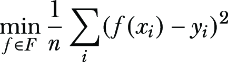
Inspect the formal supervised-learning setup connecting features, outcomes, model families, and predictions. section 4.1






























