Classification assigns text to one choice from a fixed set of categories. For example, it can choose A, B, or C for a new text. section 8.3.1
A practical pipeline labels older texts with known outcomes, converts text into embeddings, and trains a simple classifier to predict the category of new text. section 8.3 section 8.3.1
Predicting a rating category
Give old customer texts their known net promoter score ratings, represent them as embeddings, and use logistic regression to predict the rating category for new texts. section 8.3.1
Figure 8.4 LLMs produce numeric vectors known as embeddings as an intrinsic part of their function-ing. The utility of these embeddings is dependent on the fact that these numbers only change a little bit when given similar text. The two example tests here will have similar embeddings, and thus, their plots look similar, even though they don’t share any of the same words. This is a powerful feature that was present in older machine learning techniques.
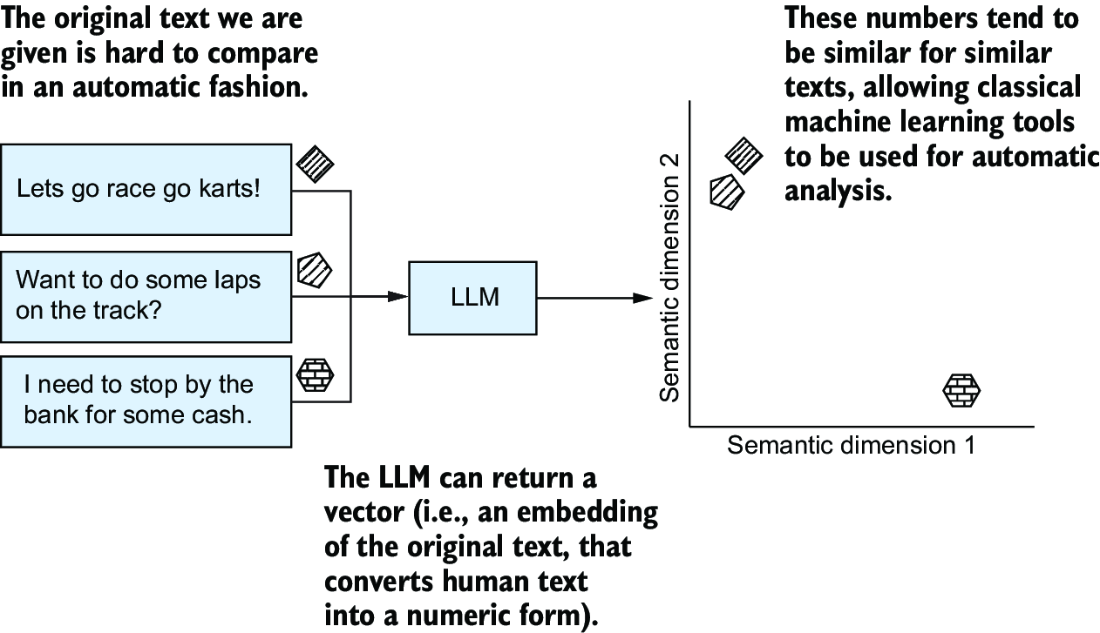
Similar texts can produce nearby numeric embeddings even when they share no words, giving classification algorithms a usable representation of meaning. section 8.3.1






























