A classifier assigns an item to a predefined class. In search relevance, binary classification separates documents into categories such as “relevant” and “irrelevant” using features including title_bm25 and overview_bm25. section 10.4.1
Learning to rank often converts a ranking problem into document-level classification. Instead of predicting an absolute relevance value, the model learns feature relationships that distinguish relevant from irrelevant documents for a query. section 10.4
A support vector machine classifier:
- Represents each item through its available features. section 10.4.1
- Finds a separating hyperplane between two classes. section 10.4.1
- Seeks few training mistakes while remaining generalizable to unseen data. section 10.4.1
- Requires feature normalization when differing feature ranges could give one feature undue influence. section 10.4.1
From animals to search results
A classifier can separate dogs from cats using height and weight. The same idea separates relevant from irrelevant search documents using signals such as title_bm25 and overview_bm25. section 10.4.1
Figure 10.2 LTR is about placing each query’s result set in the ideal order, not about predicting individual relevance grades. That means we need to look at each query as a case unto itself.
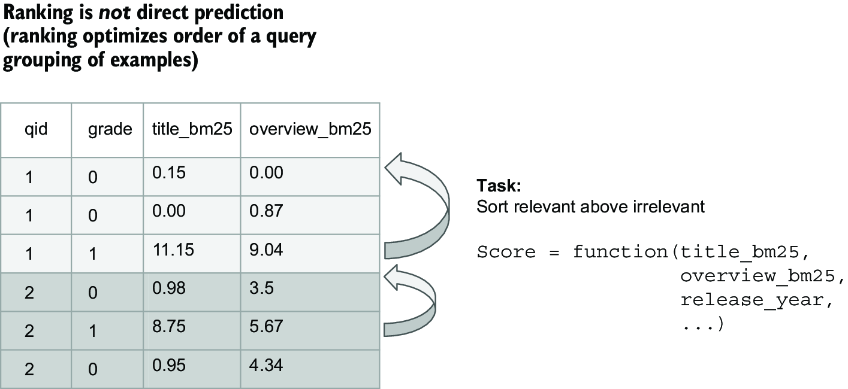
Compare document classification with ranking an entire query result set, the distinction that motivates transforming learning to rank into classification. section 10.4






























