A training dataset supplies the examples and correct answers used to teach a model. During training, the model computes loss and gradients from the entire dataset or from a batch, then updates its parameters to improve predictions. section 2.1 section 2.6
Keep the dataset’s role distinct from other dataset splits:
- Training data provides the supervision signal, such as a class label for each example. section 2.1
- A test set evaluates the final model on examples it did not see during training. section 2.1
- A validation set can help tune hyperparameters and choose among training settings. section 2.1
- Mini-batch training repeatedly computes gradients from some batch and moves weights opposite the gradient. section 2.6
Recognizing handwritten digits
For digit classification, the training dataset contains images labeled with numbers from 0 through 9. The labels tell the model which prediction is correct; a separate test set checks how it handles unseen images. section 2.1
Visualizing gradient descent steps along the loss landscape
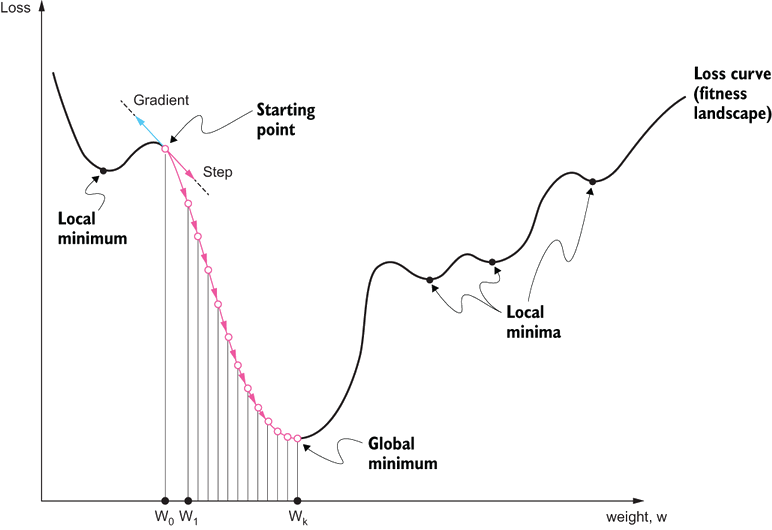
Follow the gradient-descent visualization to see how batches from the training dataset drive successive steps across a loss landscape. section 2.6



































