A training dataset is the versioned collection of examples used to train a model. In a production workflow, it links data collection and labeling to experimental training, evaluation, and later model lineage. section 1.1.3 section 10.1.3
Treat training data as a managed system artifact rather than an ad hoc file. Data engineers ingest and append labeled examples, while training code fetches a prepared dataset before training begins. A dataset service separates ingestion, storage, and fetching responsibilities. section 2.2.2 section 2.2.1
A practical training-dataset workflow includes:
- Collect and label examples from sources such as user activity logs and customer surveys. section 2.2.2
- Create a typed or generic dataset, append new data through commits, and inspect its summary, history, and statistics. section 2.2.1 section 2.2.2
- Prepare a versioned dataset, optionally selecting commits by tags such as "training set," then fetch it only after it reaches READY state. section 2.2.1
- Record the dataset version alongside code and metrics so experimental models can be traced to their inputs. section 10.1.1 section 10.1.3
Language-intent training data
A language-intent dataset can begin with 5,500 examples and 151 labels, then receive a committed batch labeled "training set." Preparation returns a version hash; fetching the READY version exposes separate examples.csv and labels.csv parts for training code. section 2.2.1
During research and prototyping, broad lawful access to training data speeds exploration. Stable, versioned inputs make repeated runs comparable; once data and code stabilize, training workflows can be packaged for production use. section 10.1 section 10.4
Figure 2.6 System overview of the sample dataset management service. The sample service contains three main components, a data ingestion API, internal storage, and a dataset fetching API.
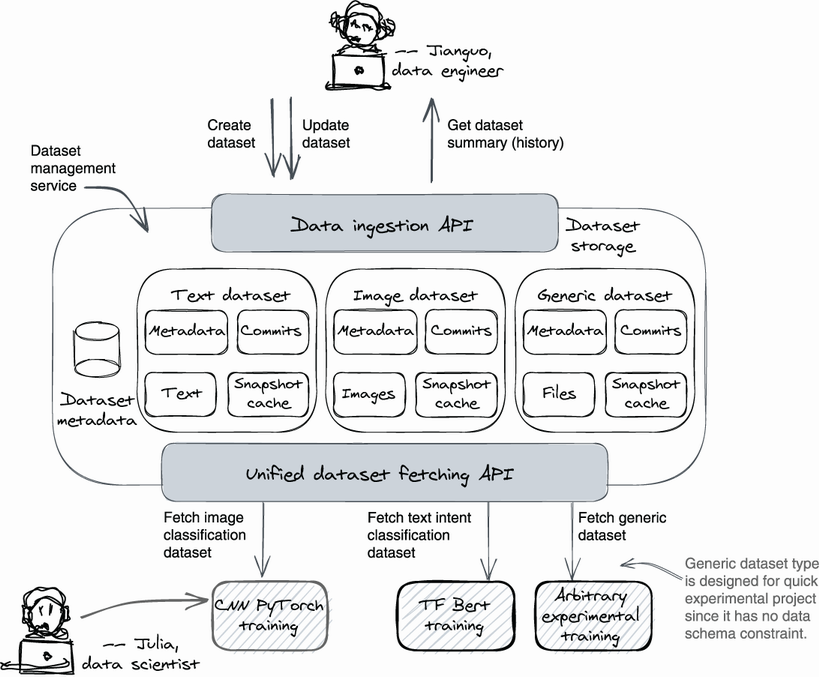
Use the service overview to locate the handoff from data ingestion and internal storage to dataset fetching for model training. section 2.2.2



































