A contract is an interface that defines how clients access a component’s functionality while hiding its implementation. A well-designed contract reduces design-time coupling: the implementation can change without necessarily affecting clients. Components collaborate by invoking operations or consuming published events. section 8.1.2 section 3.2.2
A contract’s form depends on the boundary. In a monolith, a programming-language interface can define callable methods; incompatible changes to a Java interface or its client can be caught at compilation. Between independently deployed services, the contract is language-neutral and network-based. HTTP contracts specify URLs, verbs, and request and response formats; messaging contracts specify channels, message types, and payload formats. section 8.1.2
Define a service contract with an interface definition language (IDL), such as OpenAPI for REST or AsyncAPI for messaging. The definition gives clients and servers a precise, shared specification for code generation, validation, documentation, and compatibility checks. This matters because services and clients are not compiled together: an incompatible deployment can otherwise cause a production outage. section 8.1.2
A facade for credit operations
An Order Domain Module can reserve and release credit through a ConsumerService interface instead of directly using the Consumer entity and repository. The facade hides those implementation details, can exchange data through DTOs, and is easier to mock in Order module tests. section 6.2.3
Figure 6.12 The ConsumerService facade encapsulates the implementation details of the Consumer Domain Module and reduces design-time coupling. Moreover, an Order Domain Module can easily mock the ConsumerService facade.
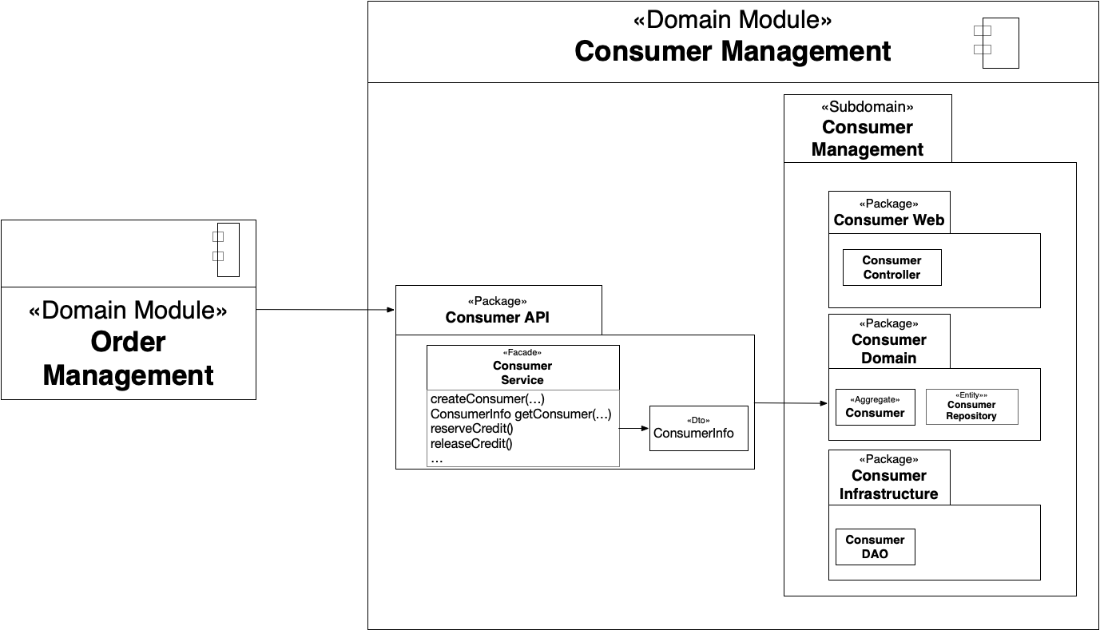
The diagram shows how the facade separates the Order module from the Consumer module’s implementation. section 6.2.3
Keep data ownership behind the contract. In a microservice architecture, a query spanning services must use API-based collaboration rather than joins across service databases; each service executes its part within a local transaction. Within a monolith, API-only module collaboration is also preferable for modularity, but a cross-module SELECT can be a pragmatic exception when a join is substantially easier or more efficient. section 12.1.5 section 6.2.3
Choose boundaries with care. A brand-new application may not yet have stable service APIs, and excessively fine-grained services can increase coupling and hurt performance. Move to microservices when there is a tangible benefit, rather than treating network contracts as an automatic improvement. section 2.3

























































