Conversational AI lets people request information, generate content, and work through tasks in ordinary language. Users can inspect a response, refine a request, and continue the exchange without learning specialized commands. This ease of interaction shifts complexity to the system and has helped conversational tools move quickly from experimentation into everyday routines. section 8.1.1 section 8.1.5
The interaction can serve several purposes at once: producing a draft, seeking guidance, or putting a concern into words. Follow-up turns allow users to clarify intentions and consider next steps, making the system useful for framing problems as well as completing tasks. section 8.5.1
Figure 8.9 Doing, Asking, and Expressing. User interactions with language models vary by intent. Doing asks the model to produce an output, Asking seeks guidance for a decision, and Expressing uses the exchange to articulate thoughts or feelings and receive a responsive continuation.
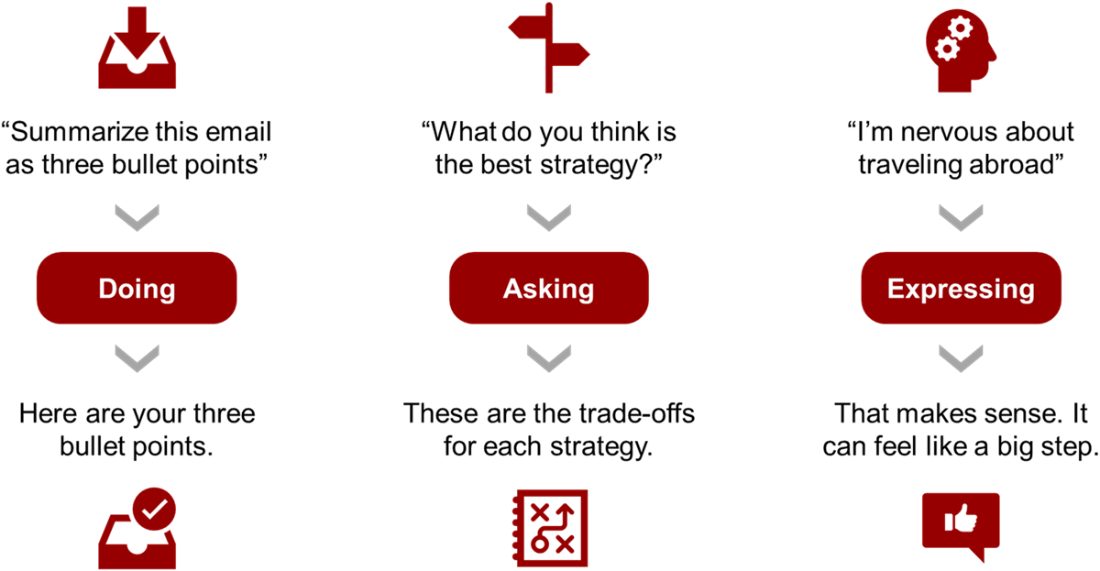
The figure distinguishes doing, asking, and expressing as three intents in conversational interaction. section 8.5.1
The same interface can support work, education, research, and personal reflection. In education, explanations, feedback, and practice can help learners engage with a subject. But generated essays or solutions weaken the link between a finished artifact and what its creator understands. Assistance can improve immediate performance while leaving less opportunity to practice the underlying skill. section 8.0 section 8.3 section 8.3.2
Assistance with essay writing
In a 2025 study, participants wrote essays with ChatGPT, with search engines, or without digital assistance. The ChatGPT group showed lower neural engagement, weaker recall, and less sense of ownership over the final text. The finding is not a final verdict on long-term learning, but illustrates the distinction between assisted output and internalized skill. section 8.3.2
Fluent responses are not necessarily reliable: language models can hallucinate, lose context, inherit bias, and produce confident mistakes. Natural conversational cues also do not establish human-like understanding or care. A response may feel attentive, especially when discussing personal concerns, even though the system responds without awareness, commitment, or responsibility. section 8.0 section 8.3.2 section 8.5.4
As conversational assistance becomes habitual, its effects extend beyond individual answers to workflows and decisions. Users may gain speed and guidance, but should still judge outputs and consider whether assistance supports their own thinking or substitutes for it. section 8.1.5 section 8.3.2

























