Accuracy is the proportion of evaluated outputs that match the correct answer or ground truth: accuracy = correct outputs / evaluated outputs. For language-model claims, correctness depends on what evidence is accepted as authoritative, so evaluation criteria should make that choice explicit. section 5.1.2
A correct answer is not necessarily grounded in the supplied context. A summary may include a true claim that does not appear in the source document. Conversely, a claim can appear grounded while being factually wrong. Accuracy alone does not distinguish these cases. section 5.1.2 section 5.5
Figure 5.3 The LLM Reliability Quadrant. Contextual grounding (vertical axis) asks whether the output stays within the provided sources. Factual alignment (horizontal axis) asks if the output is correct according to verifiable evidence. The safest output is both grounded and aligned. The riskiest output is neither grounded nor aligned. The mixed-signal quadrants are operationally important because the output can look based on source but wrong, or look correct but not grounded.
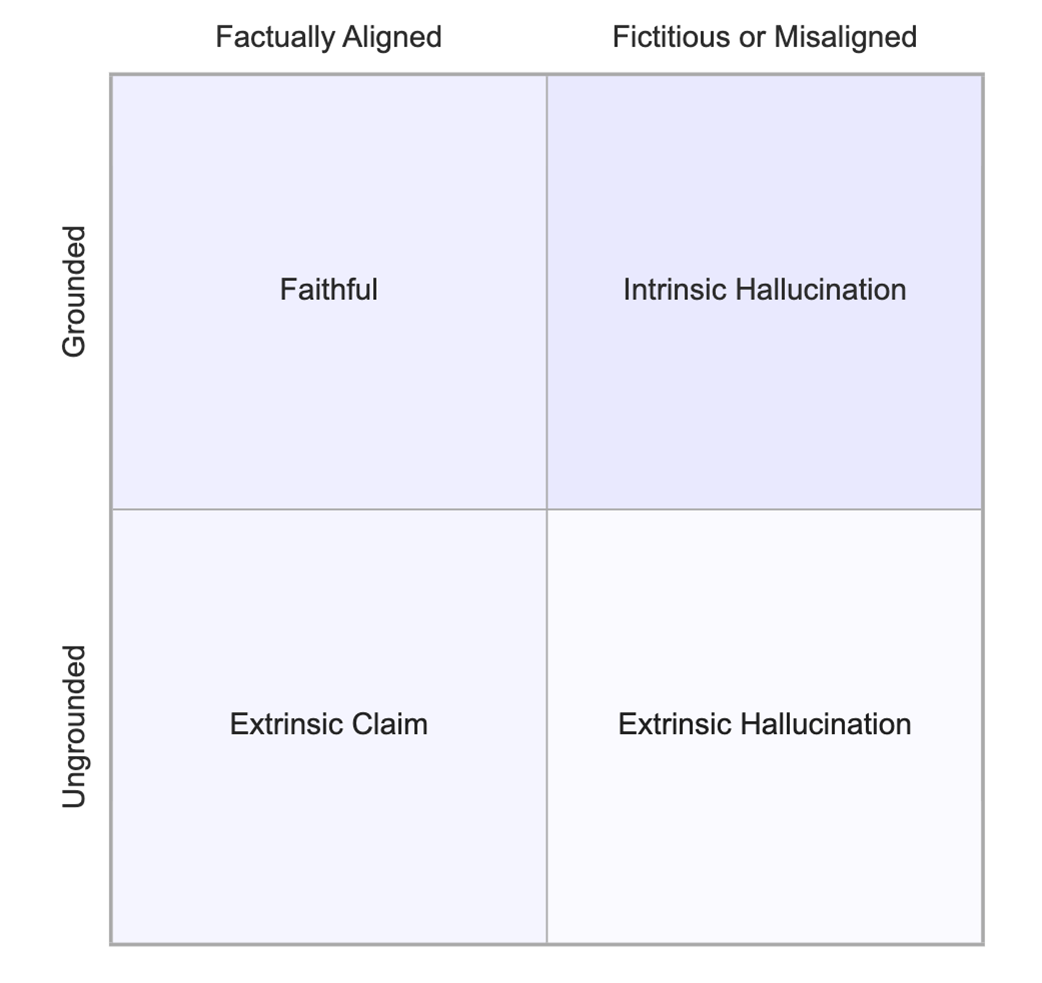
The reliability quadrant separates correctness from grounding, including cases where only one holds. section 5.1.2
In a closed-domain task, a supplied document or database provides a reference for checking claims. In an open-domain task, there is no single grounding document; checks may instead use external evidence or consistency across generations. Consistency alone can miss a claim that is repeatedly generated but wrong. section 5.1.1 section 5.5
Checking a financial summary
For a summary of a financial report, check whether each claim traces back to the report. A claim absent from the report is ungrounded, even if it happens to be true. Record grounding separately from factual correctness rather than treating them as the same result. section 5.1.2
The choice of what to evaluate matters. Classifying stated claims does not by itself capture an omitted answer: missing relevant information is a recall or answerability failure, rather than necessarily a hallucination. section 5.1.2