Deep learning extends function approximation: a neural network maps high-dimensional inputs to predictions while learning useful representations instead of relying on hand-designed features. In deep Q-learning, this provides a way to estimate values from complex states. section 8.2
Each layer applies a weighted sum and bias, followed by a nonlinear activation such as ReLU. Without nonlinearity, stacked layers reduce to one linear transformation. Deep reinforcement learning commonly uses ReLU in hidden layers and linear outputs for Q-values. section 8.2
Figure 8.4 End-to-end learning in deep neural networks
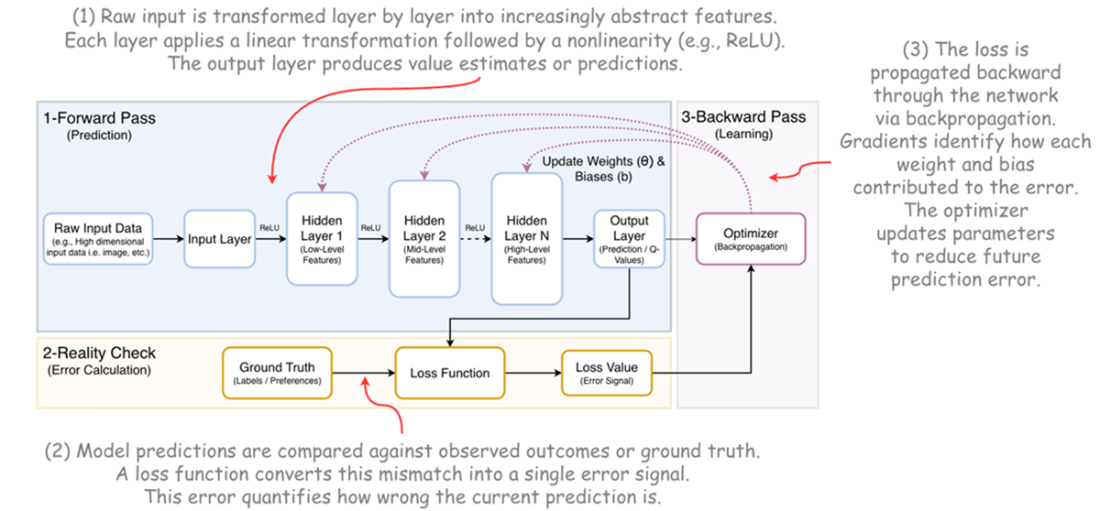
Trace the end-to-end learning loop from input through prediction and parameter updates. section 8.2
Figure 8.5 The building block of deep networks: neurons and activation functions
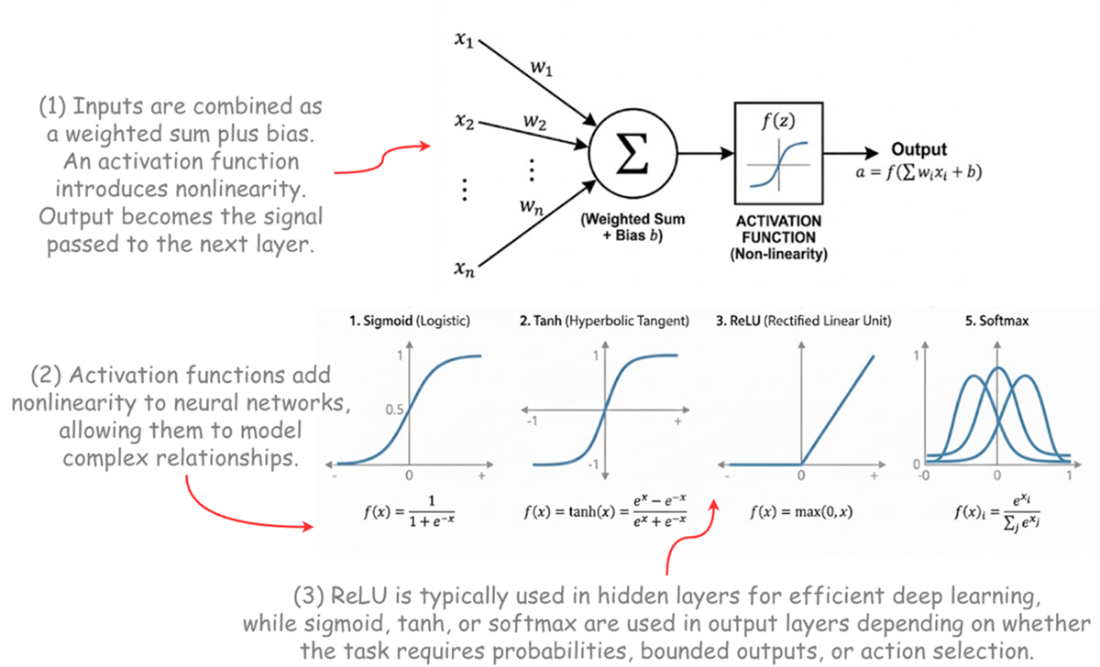
See how a neuron combines inputs and how activation functions add nonlinearity. section 8.2



















