Deep learning uses neural networks with multiple hidden layers to build representations step by step. Early layers may detect simple patterns; deeper layers combine them into more abstract features that support predictions. More depth can help with tasks involving long chains of interaction, but it also creates training challenges. section 3.1.2
From image cues to objects
A network may respond first to edges or short strokes, then combine those cues into shapes or objects. section 3.1.2
Figure 3.2 A deep neural network as a sequence of layers. The input layer receives raw data, the hidden layers transform it through learned representations, and the output layer produces the model’s prediction. In this example, the four input nodes might represent measurable features of an email, such as word frequencies or metadata, while the three output nodes might represent possible categories, such as personal, work-related, or spam. The network transforms these input features into output probabilities through the connections learned in the hidden layers.
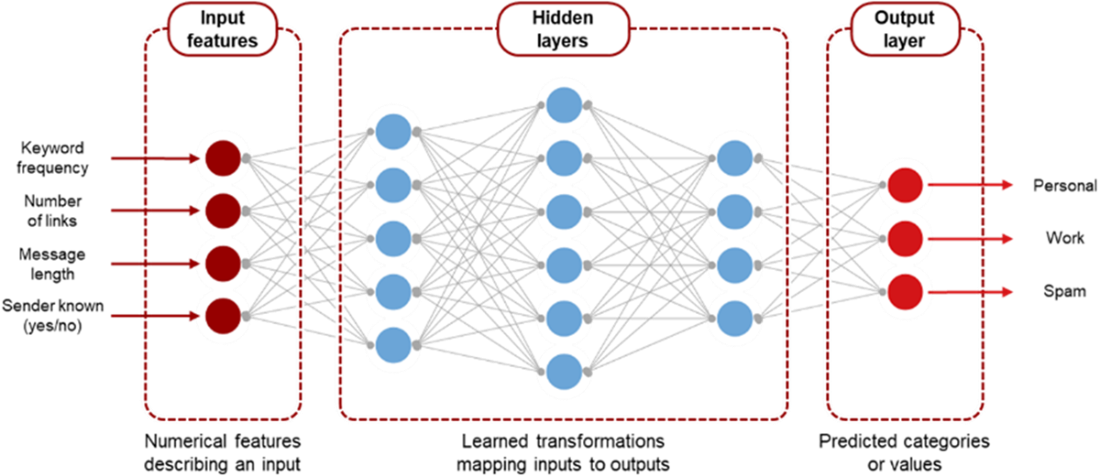
Trace how raw inputs pass through hidden layers to produce prediction probabilities, using email categories as an example. section 3.1.2