Deep learning is the part of machine learning that uses neural networks. Neural networks are especially useful when simple models cannot capture a complicated pattern, such as recognizing images or processing text. Think of artificial intelligence as vehicles, machine learning as cars, and deep learning as a high-performance car within that larger group. section 1.7 section 10.0
Figure 1.3 Deep learning is a part of machine learning.
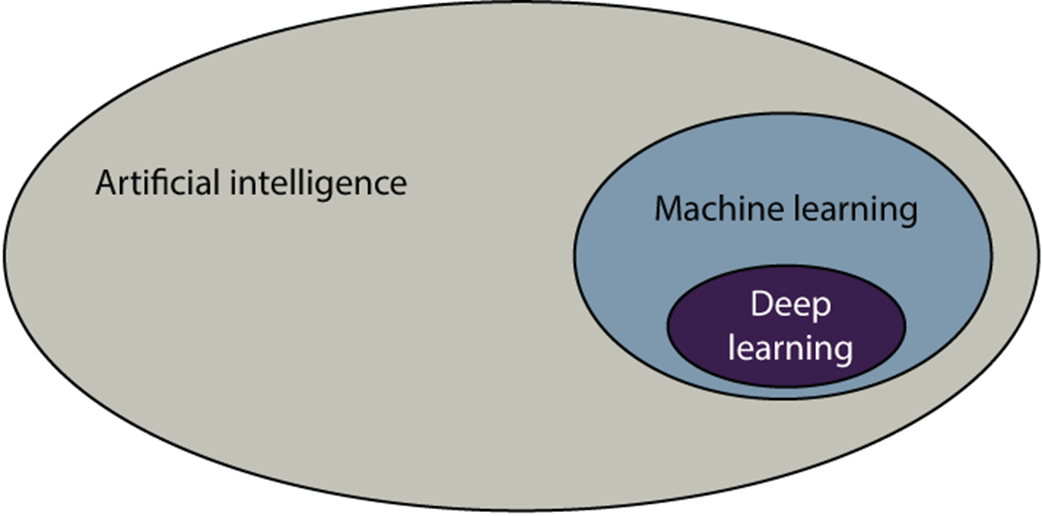
Use this diagram to place deep learning inside machine learning, which itself sits inside artificial intelligence. section 1.7
A neural network is a collection of perceptrons arranged in layers. Each perceptron combines input values with weights and a bias, then applies an activation function. Outputs from one layer become inputs to the next, allowing several simple classifiers to combine into a more complex, nonlinear classifier. section 10.5 section 10.6
Finding a pattern that one line misses
Suppose alien sentences contain the words “aack” and “beep,” and the goal is to classify the speaker as happy or sad. A single linear boundary cannot separate the two moods, but combining perceptrons can create a boundary made from multiple lines or a curve. This is the key intuition behind a neural network: layers can represent patterns that one perceptron cannot. section 10.1 section 10.7
Training adjusts the network so its predictions improve:
- Start with randomly initialized weights and biases, then define an error function to measure performance. section 10.9
- Repeatedly update weights and biases to reduce error; backpropagation uses loss derivatives to calculate those updates. section 10.25
- Use activation functions such as ReLU and softmax; dropout and regularization can help address overfitting. section 10.25
Neural networks handle classification and regression. For a two-feature dataset with a circular class pattern, a Keras network can use ReLU hidden layers, dropout, and a softmax output to learn a nonlinear boundary. For handwritten digits, reshape each 28-by-28 image into a 784-value vector, convert labels to category vectors, train, and inspect both correct and incorrect predictions. section 10.18 section 10.19
Architectures can be changed to fit a dataset and problem, which makes neural networks versatile. Their applications include image recognition, text processing, medicine, self-driving cars, and, with further changes, generating text and images. section 10.21 section 1.13