Docker packages an application with its dependencies into a container, helping the same application run across local, cloud, and production environments. This addresses dependency and operating-system differences that commonly disrupt deployment. section 3.2
Use Docker as an operational foundation for production ML systems:
- Package applications consistently before deploying them to Kubernetes or other environments. section 3.0
- Run containers through a container runtime on worker nodes, while Kubernetes schedules and replaces them. section 3.3.1
- Automate image builds and deployment through CI/CD and a container registry to reduce manual errors and accelerate releases. section 1.3.3 section 3.6
Containerizing a FastAPI service
A small FastAPI application can be developed locally with its Python requirements, tested with Uvicorn on port 8083, and then packaged into a Docker container. The same pattern applies to an ML-serving API whose dependencies include libraries such as TensorFlow, NumPy, OpenCV, and CMake. section 3.2.1 section 3.2
Figure 1.9 Model deployment consists of the container registry, CI/CD, and automation working in concert to deploy ML services.
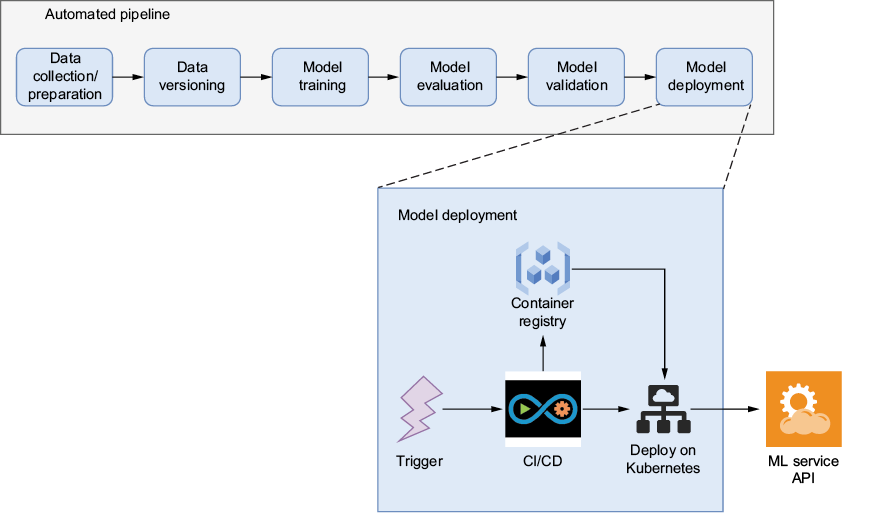
Trace how a code change becomes a rebuilt Docker image, enters a container registry, and reaches an updated ML service through deployment automation. section 1.3.3