Fine-tuning adapts a pretrained model to a narrower task, domain, or behavior through additional training. Rather than starting from scratch, it builds on structure learned from broad data and changes how the model behaves by modifying or augmenting its learned transformations. section 4.3.1
Figure 4.13 Pretraining and model adaptation. Models are first trained on broad data, then specialized through full or partial parameter updates.
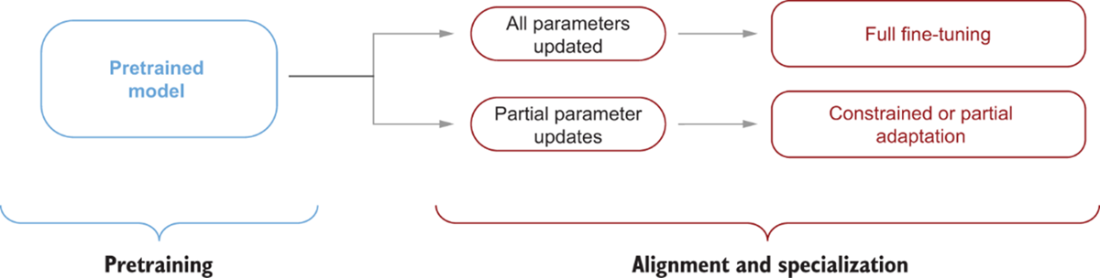
The figure contrasts broad pretraining with full and partial model adaptation. section 4.3.1
Full fine-tuning adjusts all model parameters for a new objective or domain. Partial adaptation changes a limited subset while keeping the rest frozen; it may update existing weights or introduce new trainable components. These choices differ in scope and cost. Further training can also weaken capabilities acquired during pretraining, a risk known as catastrophic forgetting. section 4.3.1
Supervised fine-tuning uses curated examples of desired behavior to shape a language model’s tone, format, role, and response patterns. Examples can also teach it to refuse harmful requests or redirect sensitive interactions. Fine-tuning can reinforce fairer responses, but the result is a learned behavioral tendency, not a guaranteed rule. section 7.5 section 7.4.4
Changing model behavior through training differs from supplying external context or filtering outputs: those interventions can guide or constrain visible responses without necessarily changing what the model has learned. Prompts and corrections within a conversation likewise do not normally alter the underlying model or persist as accumulated experience. section 7.4.4 section 9.4.4



















































