Why does the same language model sometimes continue your sentence and sometimes answer your question? Fine-tuning is additional training that changes this default behavior. A pretrained foundation model learns broad language patterns by predicting likely next tokens; fine-tuning continues training on a smaller, carefully curated set of prompt-response pairs so it learns the pattern of responding as an assistant. section 2.2.2 section 2.3
The input becomes a request
Given “Summarize this concert review in one sentence,” a raw model may treat the words as text to extend. A fine-tuned conversational model has repeatedly seen prompts paired with helpful answers, so it is more likely to interpret the same input as an instruction and return a summary. section 2.2.2 section 2.3
Fine-tuning changes behavior through a simple sequence:
- Start with a foundation model that can generate plausible continuations but may behave unpredictably in conversation. section 2.2.2
- Train further on high-quality examples of user prompts and desired assistant responses. section 2.2.2
- Learn the response pattern: answer questions, follow instructions, and organize explanations for people. section 2.2 section 2.2.2
Fine-tuning does not replace the underlying prediction mechanism. The model still predicts one token at a time; the additional examples redirect what kinds of continuations it has learned to produce. Alignment training is a related later step that uses human feedback to shape which responses people prefer and to create behavioral guardrails. section 2.2.4 section 2.3
The same approach can also make a model more specialized. After general instruction-following training, additional domain-focused training can adapt a shared foundation toward coding, law, medicine, or other kinds of data, vocabulary, and conventions. section 2.2.4 section 2.3
Figure 2.7 The same prompt, fed to two different models. The foundation model treats it as text to continue; it doesn't recognize an instruction, it simply extends the pattern. The fine-tuned conversational model reads it as a request and responds accordingly. The input is identical. What changes is how the model has learned to interpret it.
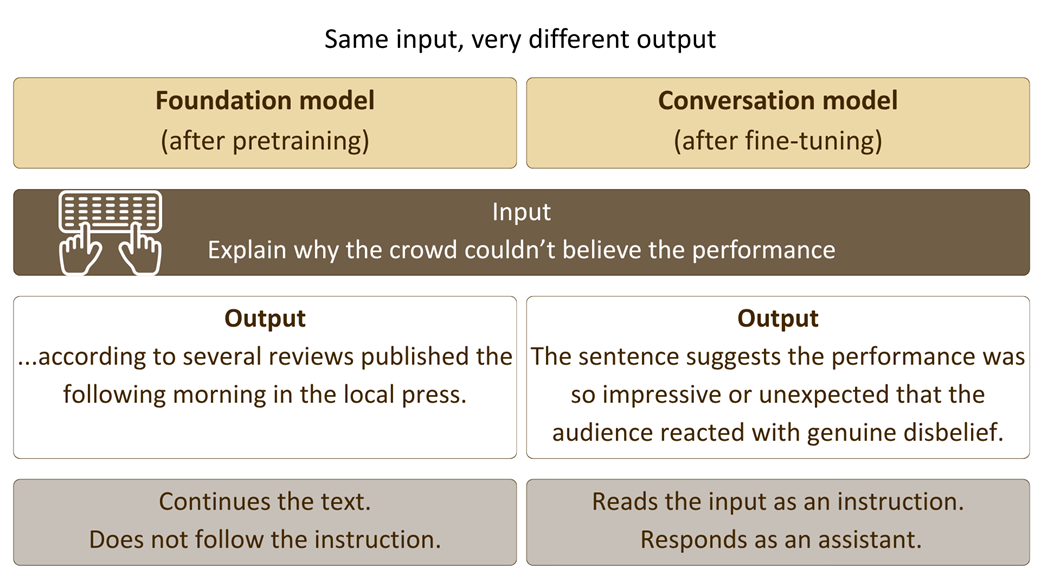
Compare identical input sent to a foundation model and a fine-tuned conversational model to see how learned interpretation changes the response. section 2.2.2



















































