liveBook · Manning

MCP server

As explained in Claude at Work

An MCP server is lightweight middleware that exposes an external system's operations and data to an AI client through the Model Context Protocol.

An MCP server is lightweight middleware between Claude and an external system. It tells Claude which operations are available and can pass data in both directions: Claude can read information or make changes. section 3.5

A connection provides several controls:

  • Authenticate directly with the connected system; Claude receives an OAuth token and acts with your access. section 3.5
  • Choose whether each action is always allowed, requires confirmation, or is blocked; data-changing actions can require approval. section 3.5

Drafting an email

Claude can use an email connector to draft a response, then request approval before carrying out the write action. section 3.5

Figure 3.7 The MCP server is the adapter between Claude’s tool list and the source system. It holds the credentials and exposes a small set of permissioned actions.
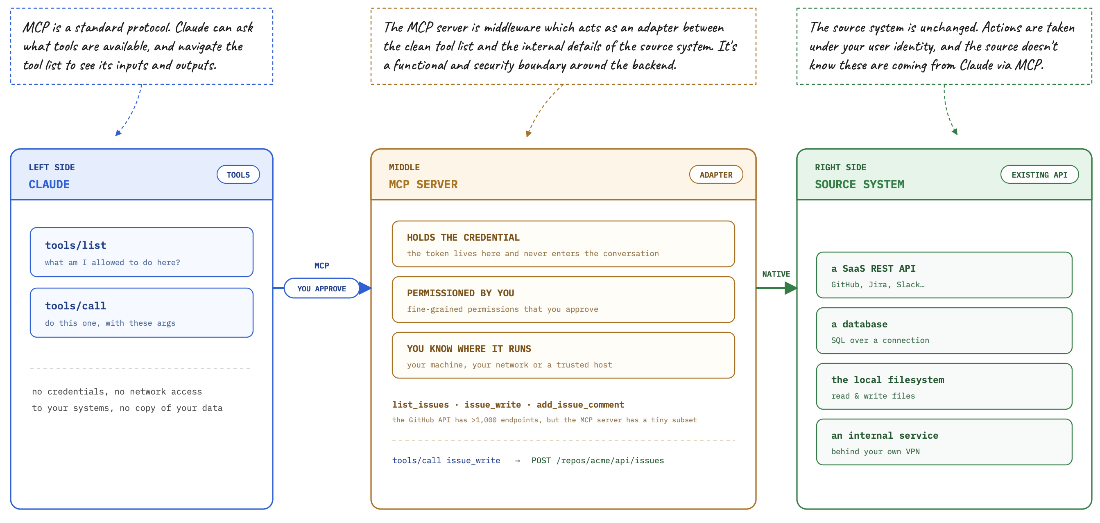
CH03 F07 Stoneman

Shows the MCP server as an adapter between Claude’s available tools and the connected system. section 3.5

How Claude at Work covers it

How deep it goes
Details middleware, OAuth authentication, bidirectional actions, and per-action permissions without implementation instructions.
Examples
Uses email drafting with approval for a write action and names GitHub, Slack, and Google Drive connectors.
What you can do after
Operate connectors by choosing whether actions are allowed, require confirmation, or are blocked.
How it connects
Connects the Model Context Protocol with OAuth authentication and service connectors.

Also explained in

Compare how 18 books explain MCP server →

Related concepts

This explainer was generated by Manning's knowledge graph from the text of Claude at Work. The section links point to the parts of the book it draws on.















