An MCP server is a lightweight program that wraps an external system—such as a database, API, or file system—and exposes its capabilities through the Model Context Protocol. “Server” describes the role of serving capabilities to AI applications, not a required deployment location: it may run locally as a subprocess or remotely as a service. section 6.4.2
Understand an MCP server through its protocol boundaries and platform responsibilities:
- Exposes tools as executable functions with JSON Schema inputs and outputs; clients discover them with tools/list and invoke them with tools/call. section 6.4.3
- May also expose read-only resources, such as files or database records, and reusable prompts for structured model interactions. section 6.4.3
- Connects to an MCP client inside an AI host; each connected server has a dedicated client connection. section 6.4.2
- Lets a platform Tool Service register external tools, centralize credentials, enforce policies, track invocations, and share one connection across applications. section 6.4.5
Registering a GitHub MCP server
A platform can register an external server at an internal URL under the namespace devtools.github, resolve credentials through a credential reference, require confirmation, and enforce a rate limit. Discovery then returns names such as devtools.github.create_issue and devtools.github.list_repos.
Figure 6.8 The integration cost progression. Without a standard protocol (left), each AI application needs custom code for each external tool, creating a multiplicative and unscalable N × M cost. With the Model Context Protocol (center), the ecosystem standardizes, reducing the integration burden to an additive N + M requirement. By introducing a platform architecture (right), the Tool Service acts as the single, universal MCP client for all applications. This abstracts the complexity away from application developers entirely, reducing the organization's integration cost to just M: one connection per tool, securely shared across every application.
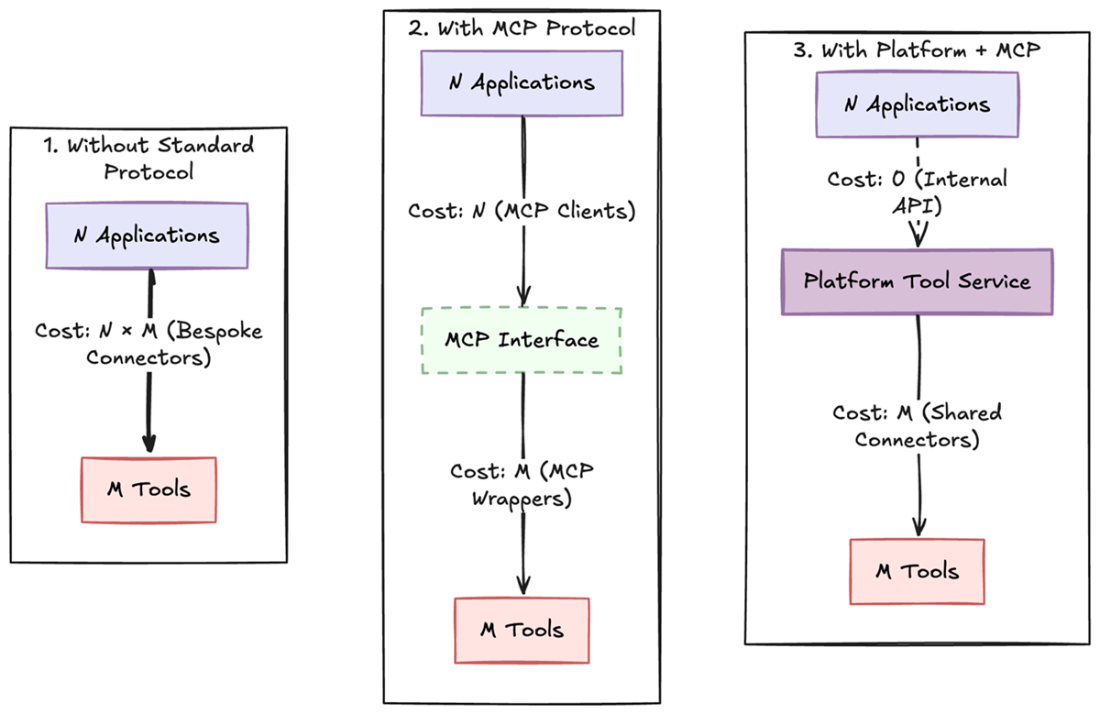
Compare direct application integrations with MCP standardization and centralized platform multiplexing: integration cost progresses from N×M to N+M to M. section 6.4.1