Model Context Protocol (MCP) standardizes how large language models interact with external data, tools, and services. It addresses bespoke model-and-tool integrations by providing a common interface for governed access to live enterprise data. section 8.2.3 section 9.3.3
In a lakehouse, MCP can enable agents to:
- Discover datasets, interpret metadata, and query governed Iceberg tables through federation or semantic layers. section 8.2.3 section 9.3.3
- Invoke functions, retrieve real-time insights, generate forecasts, or trigger downstream workflows through secure calls. section 9.3.3
- Apply authentication, authorization, row-level security, column masking, lineage, usage monitoring, and semantic definitions consistently. section 9.2.1 section 9.3.3
Governed natural-language analysis
An AI assistant identifies available datasets, uses MCP to query a federation engine such as Dremio, retrieves governed metrics, and summarizes the results while respecting role-based access controls. section 9.3.3
Figure 9.4 A natural language prompt can powerfully query and transform data using MCP servers that allow LLMs to take actions on your lakehouse. In this example, the MCP server can pull context about your data from the semantic layer and then query your data through the federation layer, allowing it to accurately fetch data to answer natural language questions.
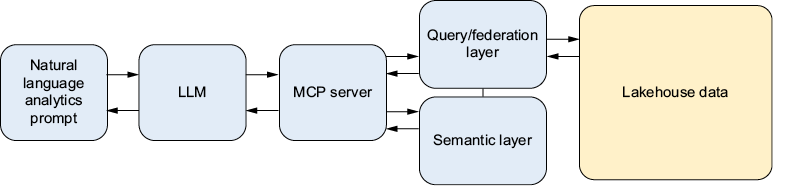
Shows how an MCP server combines semantic-layer context with federation-layer queries to answer natural-language questions accurately. section 9.3.3













