Model Context Protocol (MCP) connects language-model applications with external tools and data sources. A host is the application the user interacts with; it manages MCP clients, which communicate with servers providing services. section 9.6.1
MCP supports two connection types:
- stdio connects processes on the same machine, such as when using a local filesystem. section 9.6.1
- HTTP connects remote machines to remote MCP servers. section 9.6.1
Figure 9.5 During initialization, the agent connects to the set of MCP servers that may be used by the host, creating a pool of MCP clients to communicate with them. Whenever the agent chooses to execute an MCP-based tool, the appropriate MCP client communicates with its server, passing the necessary arguments and collecting the tool’s output.
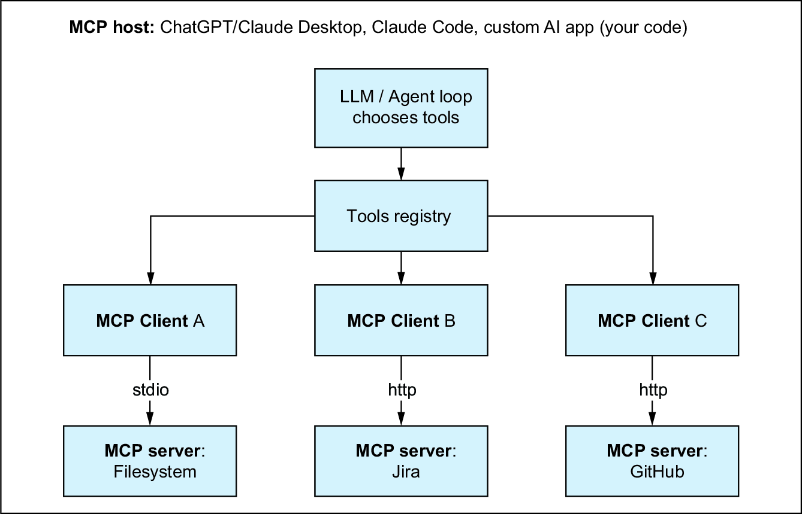
The diagram shows a host coordinating clients for multiple servers and routing tool calls through the appropriate client. section 9.6.1













