Model Context Protocol (MCP) is an open standard that gives AI applications a consistent way to discover and invoke tools exposed by servers. Like USB-C for agent tools, it creates a shared connection between many assistants and many capabilities. section 8.2
An MCP workflow separates assistants from the systems and capabilities they use:
- An MCP server exposes actions such as searching a knowledge base, retrieving orders, or running an existing flow as tools. section 8.2
- A client or tool-calling agent discovers the available tools and reads their descriptions, which act as manifests for choosing appropriately. section 8.2
- The agent invokes selected tools through the standard protocol, allowing multiple assistants to reuse a shared tool layer close to the systems it serves. section 8.2
A culinary travel assistant
A HungryTraveler assistant combines existing recipe, travel-itinerary, and email capabilities exposed through an MCP server. It discovers and calls those tools as needed, creating a destination itinerary with a matching recipe and sharing it by email. In Langflow, project flows become discoverable tools; in Python, FastMCP defines a server and decorated functions, while MCP client utilities initialize a session, list tools, and call them. section 8.3 section 8.4
Figure 8.9 MCP servers act like USB-C hubs for agents: one universal plug with many possible tools.
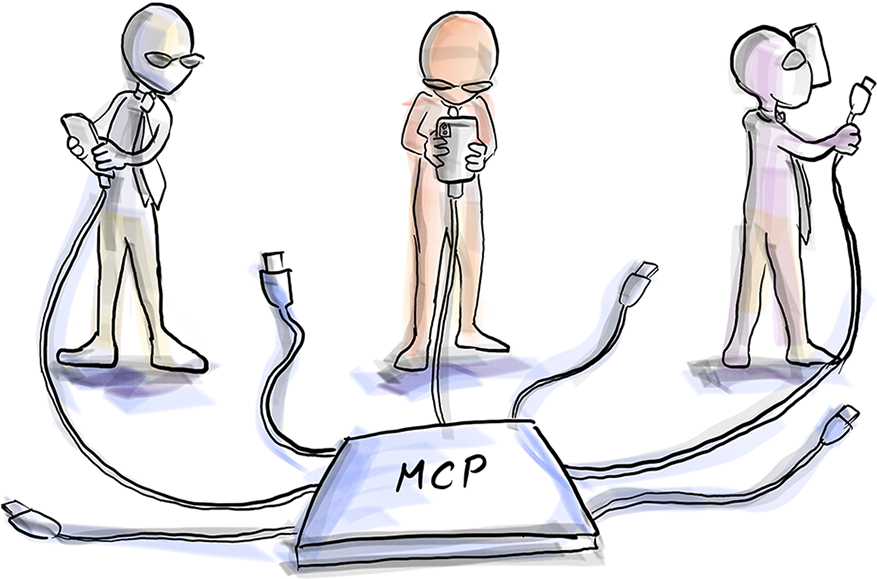
Use the USB-C hub analogy to visualize one MCP server connecting agents to many reusable tools. section 8.2













