The Model Context Protocol (MCP) is an open standard for connecting AI-powered tools with external data sources and services through secure, two-way interactions. It addresses a practical problem: AI agents need current application context and actions, but custom integrations otherwise require separate solutions. section 8.14
MCP organizes these connections around servers and clients:
- MCP servers expose selected files, database records, logs, multimedia, or internal API outputs through defined functions. section 8.14
- Servers can publish prompt templates that guide language models toward tasks such as analyzing application or system logs. section 8.14
- Servers can also publish executable tools, such as filtering logs by time period or running a Splunk query. section 8.14
- MCP clients connect models to these servers, allowing users to request actions or information through natural-language interaction. section 8.14
Querying cloud-security logs
A cloud-security worker could ask an AI client to investigate logs held in Splunk. A Splunk MCP server might run the query, filter results, or analyze irregularities instead of requiring the worker to operate Splunk directly. section 8.14
Standardization improves consistency and interoperability, reducing the effort needed to support many custom integrations. MCP is not universal access to the internet, however: clients remain limited to services that implement MCP servers. GUI-native agents offer a different path by reading screens and clicking or typing in existing applications without requiring a new MCP server. section 8.14 section 8.15
Figure 8.10 An illustration of the interaction between MCP servers and clients
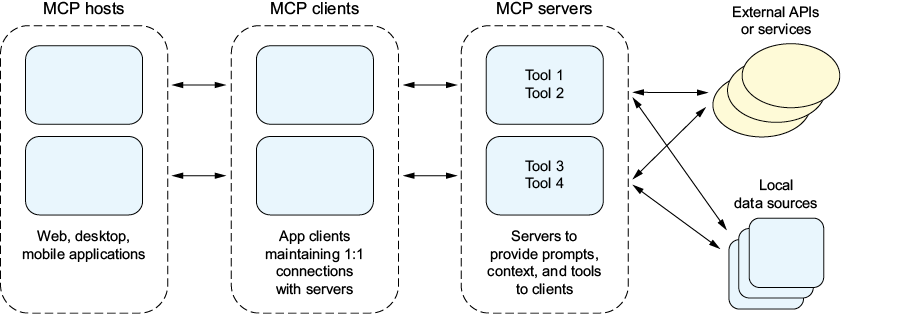
Diagram the two-way relationship between MCP servers, clients, models, exposed data, prompts, and tools. section 8.14













