Model Context Protocol (MCP) is an open specification for collecting associated tools, prompts, and resources into reusable modules that AI applications can share. It connects applications to external capabilities such as databases, filesystems, and APIs. section 7.0 section 7.6
MCP divides the integration into two cooperating components:
- An MCP Server accesses a resource and exposes it through one or more tools. section 7.1
- An MCP Client runs inside an AI application, retrieves the server’s tools, places them in prompt context, and invokes them for the LLM. section 7.1
- Servers can communicate through STDIO, HTTP with Server-Sent Events, or Streamable HTTP, although Spring AI 1.0.0 supports only STDIO and HTTP+SSE. section 7.1
Figure 7.1 Interactions between MCP Servers and MCP Clients
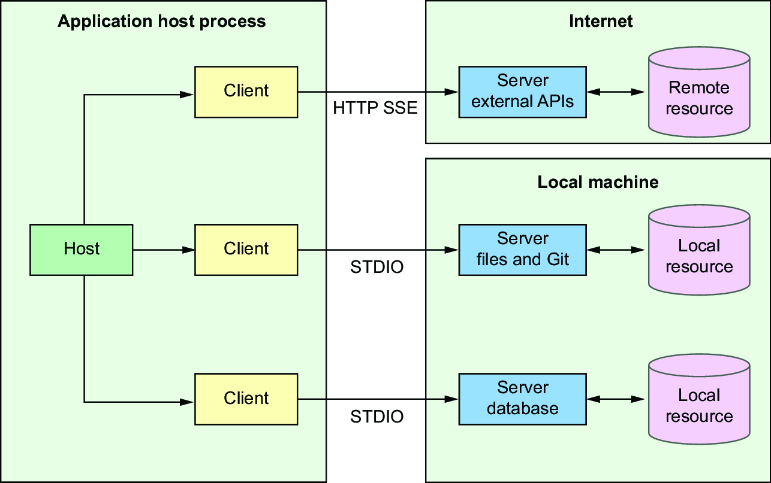
Use the interaction diagram to trace how an MCP Client discovers and invokes tools exposed by an MCP Server. section 7.1













