liveBook · Manning

Visualization

As explained in Collaborative Software Design: How to facilitate domain modeling decisions

Visualization is the representation of concepts, relationships, or processes in a visual form to support reasoning and communication.

Visualization makes concepts, relationships, and processes explicit so people can reason together. In collaborative modeling, it exposes memory limits and misunderstandings that ordinary conversation can hide, creating a shared understanding of complex business problems. section 2.1.2 section 1.4

Use visualization to make collaborative decisions more concrete:

  • Model the conversation with a lightweight visual form such as EventStorming rather than relying on memory alone. section 2.1.2
  • When a conversation is not being visualized, lead by example and make the discussion visible. section 7.5
  • Use little structure initially, model something incorrectly when useful, and ask what evidence could change a conclusion. section 7.5
  • Provide accessible tools and examples so participants can take ownership without treating visualization as a complete solution. section 7.5 section 1.2.1
Figure 2.1 Visualization of the conversation with the business stakeholders at BigScreen on extending movies using EventStorming. domain events are business-relevant events that happen in a conversation. We’ll go more in-depth on how EventStorming works later in the chapter.
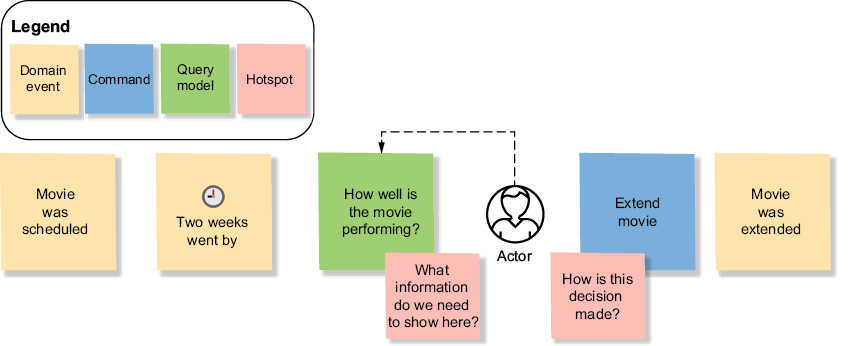
A movie-streaming conversation is mapped with EventStorming, using domain events to turn stakeholder discussion into a shared visual model. section 2.1.2


How Collaborative Software Design: How to facilitate domain modeling decisions covers it

How deep it goes
Explains cognitive and social benefits, gives facilitation heuristics, and stops short of prescribing detailed notation.
Examples
Uses EventStorming for a movie-streaming discussion, plus dependency graphs, state tables, examples, and deliberately imperfect models.
What it assumes
Assumes participation from relevant stakeholders and decision-makers while teaching the need for explicit models from basic dialogue.
What you can do after
Evaluate/understand business problems, expose misunderstandings, compare alternatives, and support informed group design decisions.
How it connects
Connects visualization with collaborative modeling, EventStorming, shared understanding, facilitation, and cognitive bias.

Also explained in

Compare how 16 books explain visualization →

Related concepts

This explainer was generated by Manning's knowledge graph from the text of Collaborative Software Design: How to facilitate domain modeling decisions. The section links point to the parts of the book it draws on.













