A database provides external storage for data that cannot remain directly in program memory. Applications treat data storage as an abstraction, while the underlying system may be relational, key–value, filesystem-based, or cloud-based. section 11.0 section 3.2.2
Designing database persistence requires decisions at several levels:
- Clarify requirements first, because they shape storage choices and database behavior. section 12.2
- Choose the storage technology, access method, libraries, and database management approach. section 12.2
- For relational systems, define schemas, tables, relations, normalization, indexes, queries, views, and server-side functions. section 12.2
- Keep the application architecture independent by placing the database behind an abstraction or subsystem interface. section 3.2.2 section 3.2.3
Database in an application architecture
The Andromeda Control Software places a relational database alongside the GUI and business logic. Each major area has its own abstraction, while a central layer connects the application’s components. section 3.2.3
Figure 3.13 Architecture diagram for the Andromeda Control Software
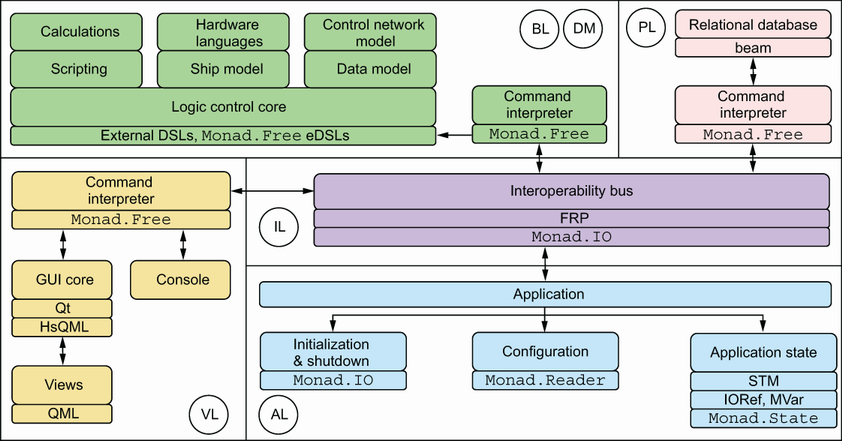
Use the architecture diagram to trace how the relational database relates to the GUI, business logic, central layer, configuration, and application state. section 3.2.3























