liveBook · Manning

Database

As explained in Simple Object-Oriented Design: Create clean, maintainable applications

A database is a system that persistently stores and retrieves structured application information.

A database persistently stores an information system’s data. Backend actions commonly retrieve, insert, update, or delete that information, making the backend strongly database-centric. section 1.4

A database participates in a larger backend architecture:

  • A frontend sends requests to the backend. section 1.4
  • Controllers convert requests into commands for the domain model, which applies business rules. section 1.4
  • Repositories contain retrieval and persistence logic and communicate with the database behind the scenes. section 1.4
  • External systems and APIs can exchange information with the backend while the database remains its central store. section 1.5

Training-management application

A training platform stores employees, courses, trainers, enrollments, and reports in its database. Its backend retrieves and changes these records, while APIs and a frontend provide access to the functionality. section 1.5
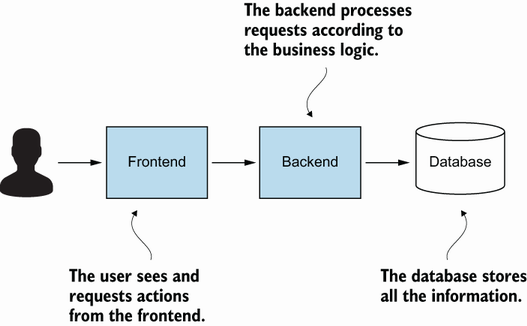
Figure 1.8 A traditional information system with a frontend, a backend, and a database

Use the architecture diagram to trace how the frontend, backend, and database divide responsibilities. section 1.4


How Simple Object-Oriented Design: Create clean, maintainable applications covers it

How deep it goes
Defines the database’s architectural role and access boundary but defers storage technology and implementation details.
Examples
Uses training courses, employees, trainers, enrollments, reports, and notifications as stored application information.
What you can do after
Understand how a database fits into a backend and how repositories isolate persistence logic.
How it connects
Connects databases with frontend, backend, MVC, controllers, domain models, repositories, APIs, and external systems.

Also explained in

Compare how 24 books explain database →

Related concepts

This explainer was generated by Manning's knowledge graph from the text of Simple Object-Oriented Design: Create clean, maintainable applications. The section links point to the parts of the book it draws on.





















