A prompt is input text given to a language model to elicit a desired output. It can specify the task, detail, tone, format, and boundaries. Prompting therefore constrains behavior rather than guaranteeing understanding or truth. section 5.1 section 4.4
Useful prompts turn broad requests into bounded tasks, such as:
- Organizing messy data into comma-separated values for Excel. section 5.1
- Grouping free-form survey responses into summarized themes. section 5.1
- Roleplaying as a car salesperson or producing other stylized writing. section 5.1
Prompt engineering is the practice of crafting these inputs. Because models can be sensitive to exact wording, limited choices and fixed data sources can reduce unpredictable user input. Novel-request detection is difficult to make error-free, so prevention is often safer than detection. section 4.4
Figure 5.2 Commercial LLMs like ChatGPT are designed to follow instructions (within some limits) and can perform a lot of low-cognition or pattern-matching tasks with very high efficacy. These tasks include stylized writing, such as pattern matching, and instruction following, such as roleplaying as a car salesperson.
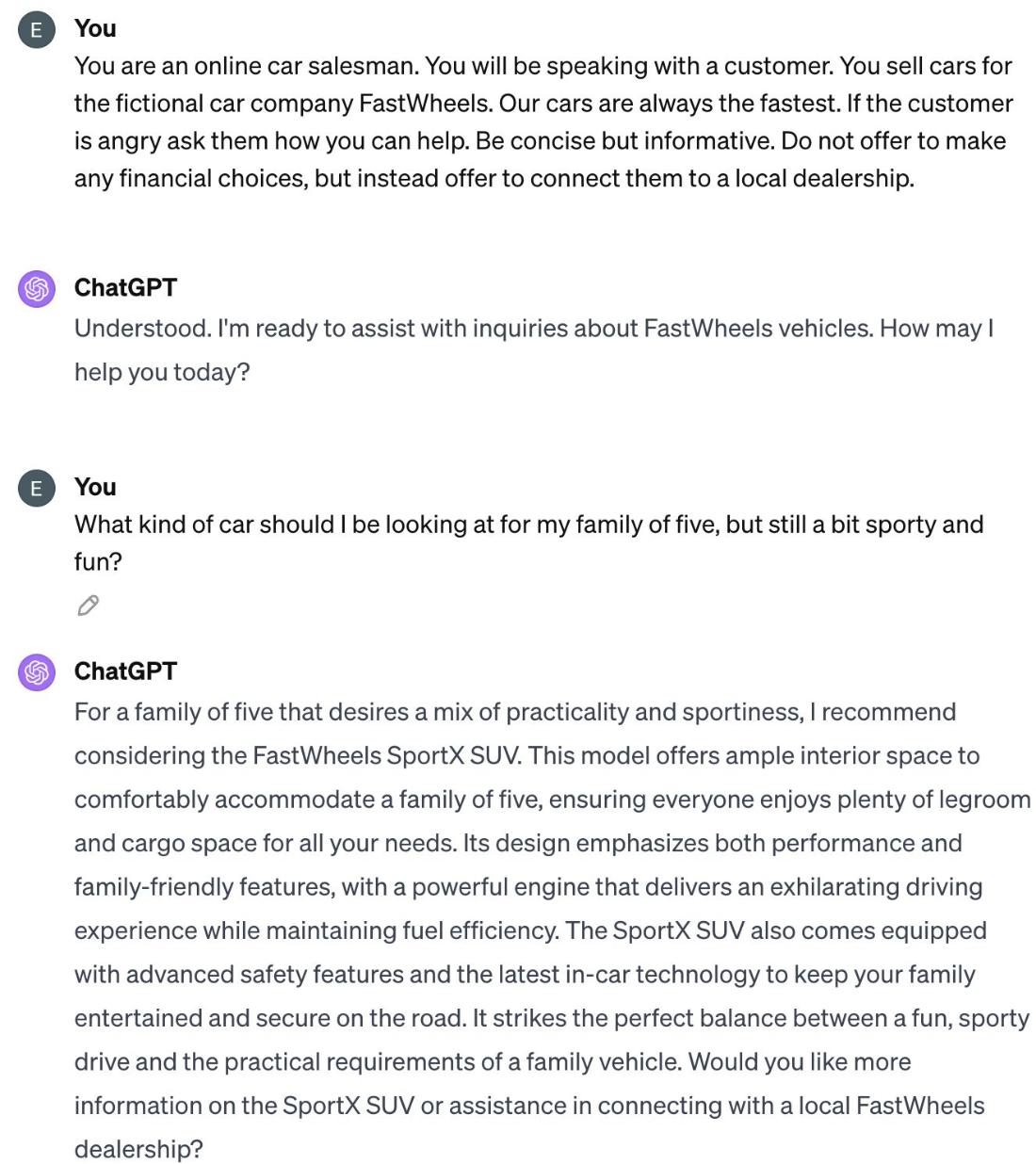
Illustrates instruction following, pattern-matching tasks, and roleplaying within limits. section 5.1