Structured data organizes information according to a predefined schema, making records directly queryable through consistent fields. In a SQL database, each row contains columns with defined data types, including discrete values such as identifiers and continuous values such as numbers or date ranges. section 2.1.2
Relationships are represented explicitly through shared identifiers. A foreign key in one table refers to an entity in another, allowing joins to combine related rows into a composite record. This model contrasts with unstructured data, where comparable relationships must be discovered from flexible content. section 2.1.2 section 2.1.3
Employees joined to companies
An employees table can contain a company_id column, while a companies table contains the corresponding id. Joining these fields links each employee to the relevant company. The same relationship pattern can guide search systems when separate documents share an identifier or recognizable entity. section 2.1.2 section 2.1.3
Figure 2.3 Structured data in a typical database. Discrete values represent identifiers and enumerated values, continuous values represent data that falls within ranges, and foreign keys exist when the same value exists across two tables and can thus be used as a shared attribute that creates a relationship between corresponding rows from each table.
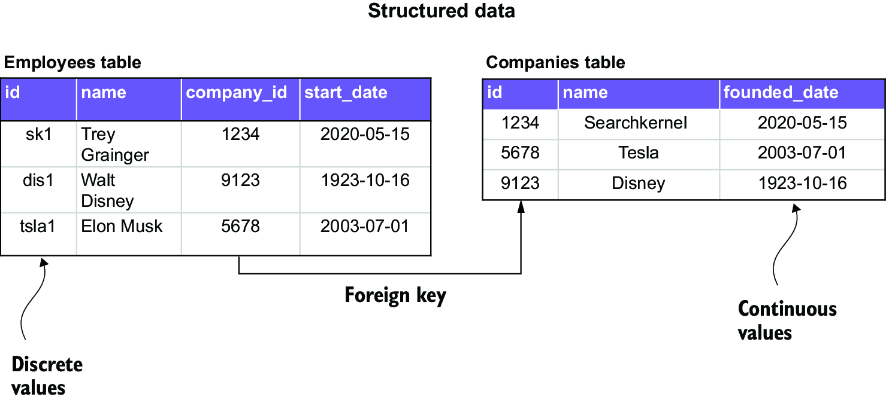
Use the database diagram to compare discrete identifiers, continuous values, and foreign-key relationships across tables. section 2.1.2























