Structured data organizes related values into predictable forms such as tables, relational databases, or graph databases. In retrieval systems, it complements vector search when answers depend on precise records rather than only similar text. section 8.1.2 section 8.6
Use structured data in retrieval pipelines by:
- Routing questions to the content store that contains the needed data, instead of relying only on a vector store. section 8.1.2
- Generating structured queries such as SQL when relational or graph databases cannot process natural-language questions directly. section 8.1.2
- Filtering or postprocessing retrieved results before passing relevant context to the language model. section 8.1.2
- Extracting tables from mixed documents, storing complete tables separately, and embedding summaries for discovery. section 8.6
Embedding a table alongside text
A document containing prose and a table can be split into coarse text chunks while the full table is stored in a document store. A summary of the table is embedded in a vector store. When a question matches that summary, MultiVectorRetriever returns the complete table for answer synthesis. section 8.6
Figure 8.8 Embedding structured and unstructured content. Structured data, such as tables, should be summarized and embedded just like unstructured text chunks. This ensures that the embeddings match detailed questions as effectively as text embeddings. Use the MultiVectorRetriever to manage both types of content.
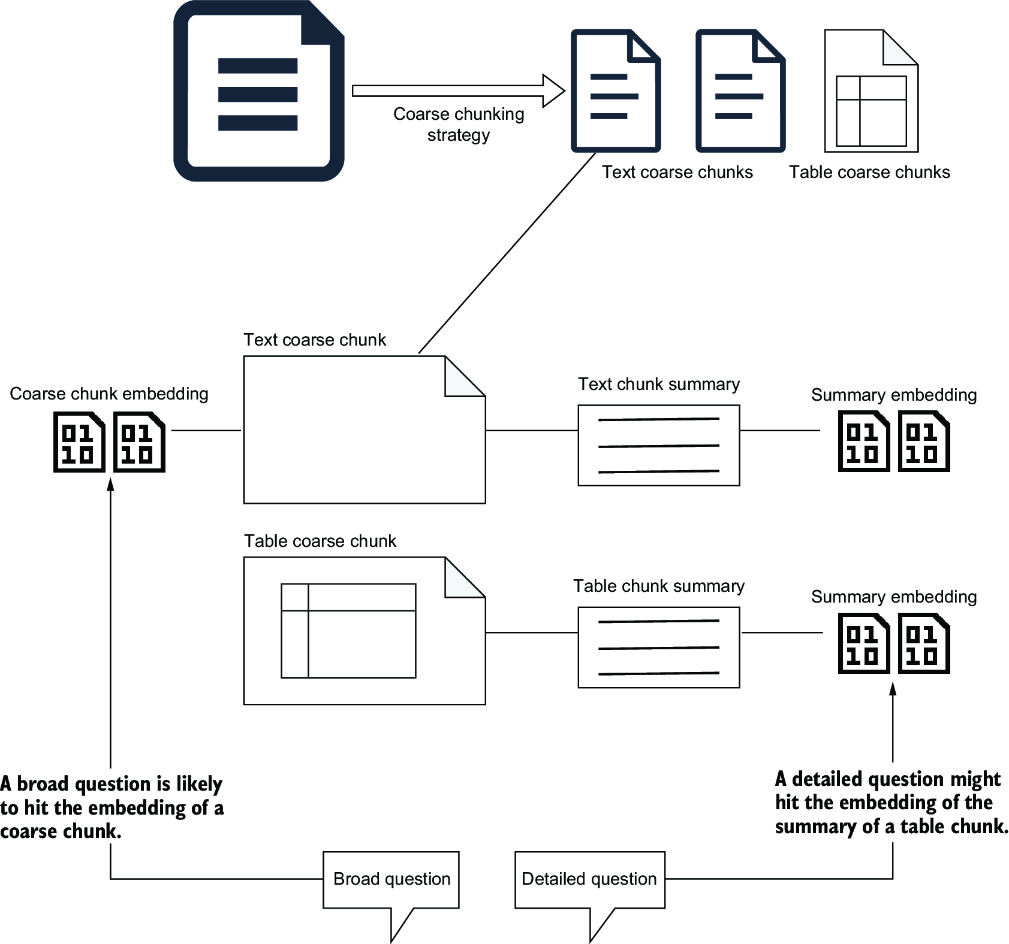
Shows how summarized structured and unstructured content can share an embedding-based retrieval path while preserving the full table for synthesis. section 8.6























