liveBook · Manning

Structured data

As explained in Machine Learning Platform Engineering

Structured data is data organized according to a defined schema that makes its fields and relationships machine-readable.

Structured data organizes machine-readable fields into a consistent format that production ML pipelines can collect, transform, validate, split, and store. Tabular data is especially useful because it is already numerical or can be converted into numerical features. section 1.4.2 section 9.3

A production workflow uses structured data to:

  • Save prepared datasets as Parquet files and place them in a data lake or MinIO bucket. section 9.3
  • Create train, test, and validation splits before model training. section 9.3
  • Run data-quality checks before training and define validation metrics for model assessment. section 9.3
  • Support feature stores, drift detection, model testing, observability, and experiment tracking. section 1.4.2

Movie recommendation pipeline

A MovieLens-based recommender collects structured data, saves it as Parquet, stores it in MinIO, creates dataset splits, checks incoming quality, trains a model, and tracks experiments and model versions with MLflow. section 7.0 section 9.3

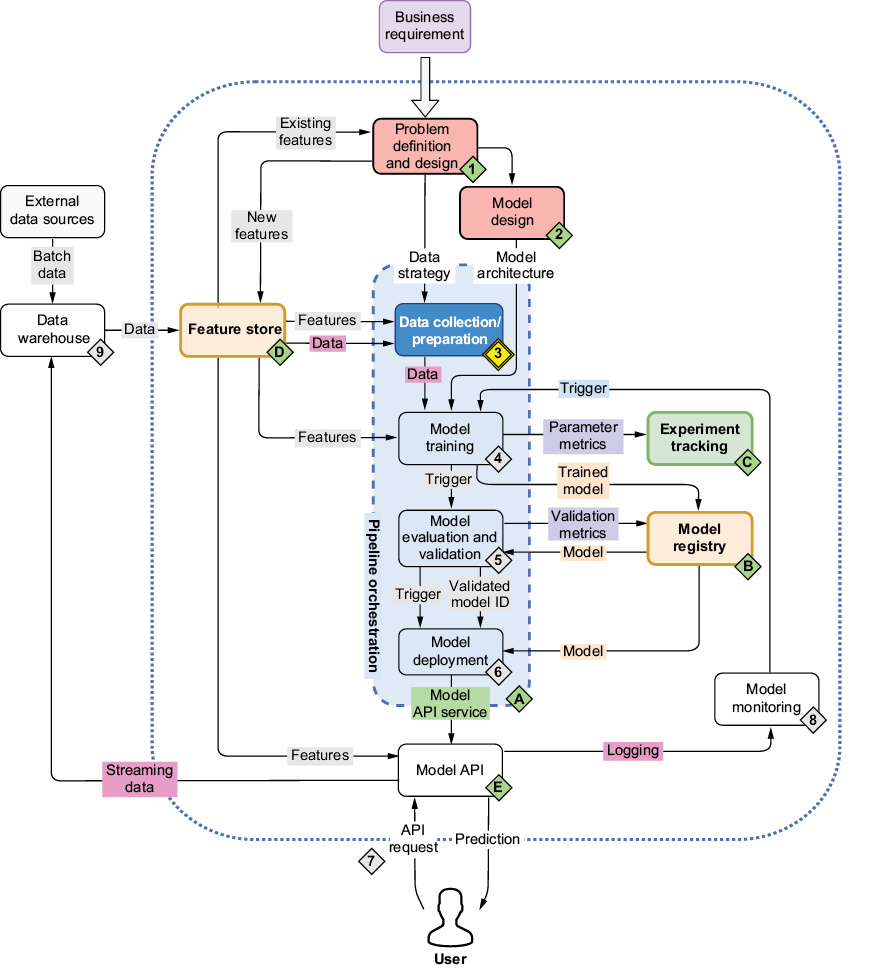
Figure 7.1 The mental map where we’re now focusing on the first step/component of our pipeline—data collection and preparation (3)
A screenshot of a computer

AI-generated content may be incorrect.

Use the pipeline mental map to locate structured data within the collection and preparation stage that feeds later training and validation. section 7.0


How Machine Learning Platform Engineering covers it

How deep it goes
Explains storage, splitting, quality checks, and tooling integrations, but defers data exploration and recommendation algorithm details.
Examples
Uses the MovieLens dataset, Parquet files, MinIO storage, train-test-validation splits, and a movie recommendation pipeline.
What it assumes
Assumes a working Kubeflow setup and sufficient execution hardware while using simpler examples to establish pipeline concepts.
What you can do after
Apply it via a reproducible pipeline that prepares, validates, stores, and supplies structured datasets for model training.
How it connects
Connects structured data with tabular data, feature stores, data lakes, data validation, model training, drift detection, and observability.

Also explained in

Compare how 24 books explain structured data →

Related concepts

This explainer was generated by Manning's knowledge graph from the text of Machine Learning Platform Engineering. The section links point to the parts of the book it draws on.





















