Model variance describes how much a model’s fitted predictions change when the training data changes. High variance means the model is sensitive to its particular training sample and may fit noise, performing worse on unseen data. section 4.4 section 4.4.1
Variance is considered alongside bias: simpler models may underfit, while highly flexible models can overfit. Learning curves reveal variance through the gap between training and test error; validation curves show how that gap changes with model complexity and hyperparameters. section 4.4.2 section 4.4.3
Use the observed variance to guide modeling choices:
- Collecting more training data can reduce overfitting; if errors have converged, more data may not help. section 4.4.2
- Regularization and decision-tree pruning can reduce variance, usually at the cost of increased bias. section 5.3.1
Polynomial models for solubility
A 20th-order polynomial can fit training noise and vary substantially across data splits, while a 2nd-order model may be too simple to capture the target pattern. Learning curves compare RANSAC and SVR to help assess whether more data could reduce overfitting. section 4.4.1 section 4.4.2
Figure 4.18 How high bias or high variance impact a model’s sensitivity to the training data it learns from.
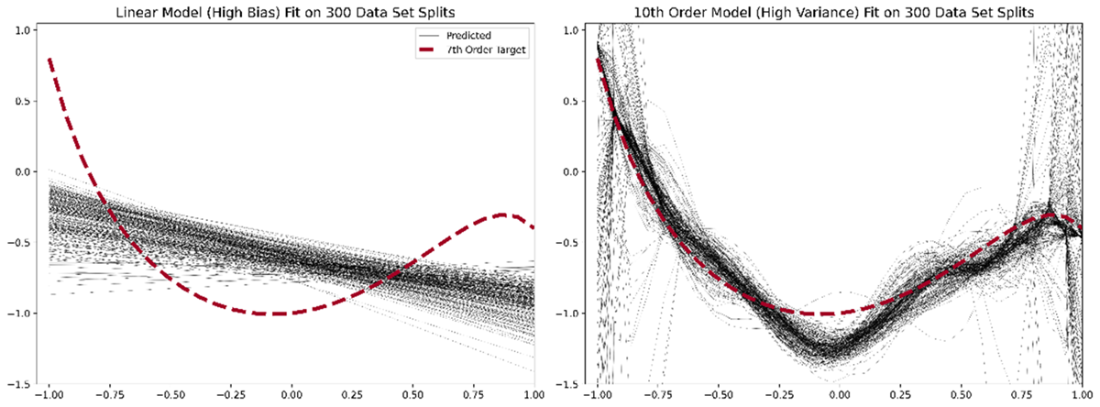
Compare how high-variance fits change with the training data. section 4.4.1























