Variance measures how widely possible values spread around their mean. It equals the expected squared deviation from the mean and the square of the standard deviation. section 3.12
For a normal distribution, variance is written σ². A larger variance means a broader distribution and greater uncertainty; a smaller variance means a more concentrated distribution. section 3.12
Variance in a Bayesian regression update
A prior slope with μ = 100 and σ = 100 has variance σ² = 100². After observing square-footage and price data, the posterior variance is updated with the data and typically decreases, expressing greater confidence in the slope. Python computes this posterior variance with the prior variance, feature values, and noise variance. section 3.14 section 3.12
Figure 3.4 The prior distribution of the slope 𝑚 in the linear regression model, which gives the highest probability to the value 100 but there’s a high level of uncertainty in this value, quantified by the large spread of the distribution.
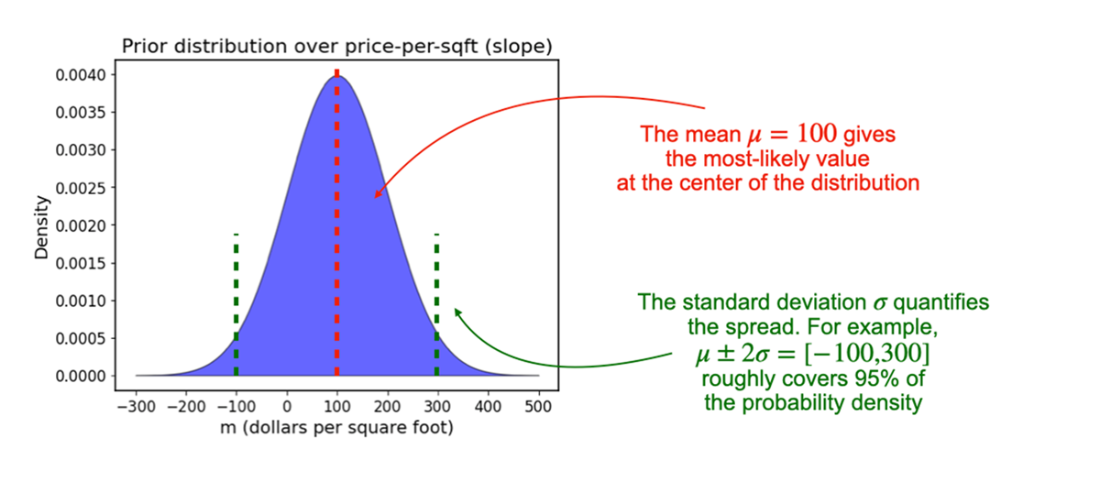
Visualize how variance appears as the spread of a normal prior around its mean. section 3.12
Variance is useful for continuous quantities, but it is not a universal uncertainty measure. It does not naturally describe categories such as “dog” and “cat,” and it can change when numerical possibilities are relabeled or rescaled even when uncertainty remains the same. section 13.3























