A vector database stores and indexes embeddings so records can be retrieved by semantic similarity. In episodic memory, it supports recalling past task episodes relevant to a current query. section 7.1.2 section 7.3.2
A similarity-search workflow:
- Represent each episode and the query as embeddings in the same space. section 7.3.2
- Index episodes in the database, then retrieve those closest to the query; cosine similarity is one distance measure. section 7.3.2
- With QdrantMemoryStore, write() embeds and persists an episode; search retrieves up to max_results similar episodes. section 7.3.2
Recall a related episode
A query for “Hailstone sequence starting from 6” retrieves the stored episode for computing the sequence for 6. section 7.3.2
Figure 7.5 Recording an Episode as a point in the embedding space and recalling the most similar Episode objects to a given query
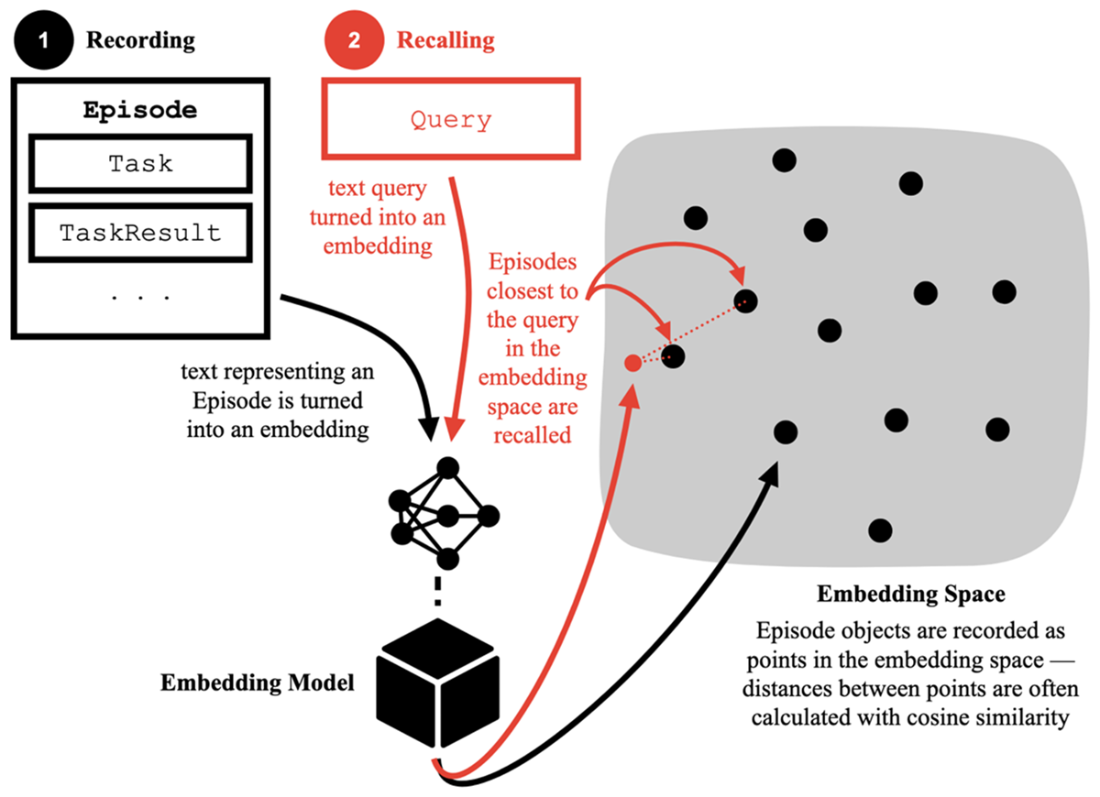
Shows an episode and query represented in embedding space, with similar episodes retrieved for the query. section 7.3.2