Continuous improvement revises an agent’s actions, strategy, or output using feedback from earlier attempts. It can happen within a task or across evaluation and deployment. section 5.1.2 section 11.1.5
The improvement loop can operate at different levels:
- Within a task, the agent acts, observes the result, and uses it to choose what to do next. section 5.1.2
- Across drafts, writing and summarization can benefit when each iteration improves the output. section 9.2.7
- Across deployment, measure behavior, capture human feedback, evaluate results, and optimize. Add a loop only when iteration helps; it can add latency and cost to single-pass tasks. section 11.1.5 section 9.2.7
Figure 5.3 The ReAct paradigm of reasoning in a sequential diagram. The agent thought process occurs in the loop, where the LLM first reasons, plans, and then executes the plan. After each execution of a task (tool), the LLM observes the output and then reasons about whether it needs to continue looping or whether the plan has been completed.
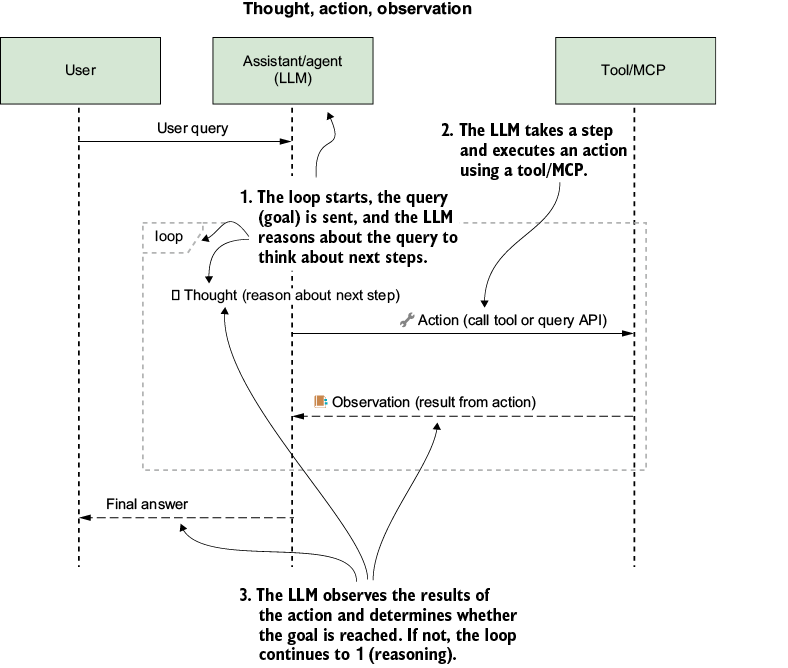
The diagram traces the task-level cycle: reason, act, observe the result, then continue or stop. section 5.1.2





























