Closed-loop control measures a system’s output, compares it with a desired value, and adjusts its input to reduce the difference. A thermostat, for example, tracks room temperature and switches heating or cooling to approach its setpoint. section 8.7
Figure 8.17 PID-based closed-loop control system—the PID controller takes the error signal and produces a control signal to reduce the error to zero.
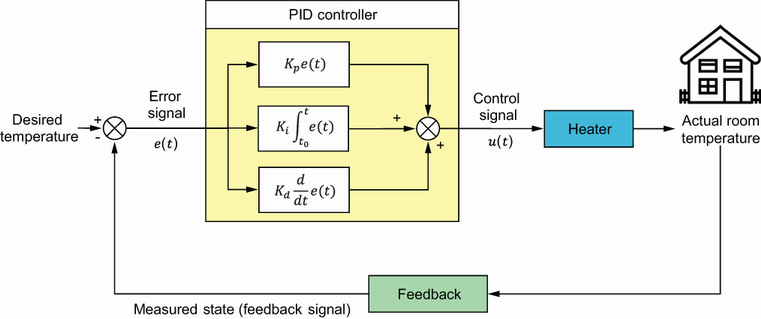
The diagram shows how a PID controller turns the difference between desired and measured states into a control signal. section 8.7
A PID controller combines proportional, integral, and derivative terms to respond to error, its accumulated magnitude and duration, and its rate of change. Genetic algorithms can tune the controller’s Kp, Ki, and Kd parameters against a selected response objective. section 8.7 section 8.7





























