A feedback loop turns design into an ongoing cycle: gather information, challenge the current model, adjust decisions, and repeat. It replaces the assumption that discovery, strategy, and implementation form a finished linear sequence. section 11.3 section 11.3.1
The loop matters because decisions are made under uncertainty. New perspectives, conversations, conflicts, biases, requirements, and implementation conditions can all reveal that the model needs revision. Treat models, designs, and decisions as living artifacts rather than possessions. section 11.3 section 11.3.1
Use the loop to keep collaborative modeling responsive:
- Revisit discovery with new or different participants; a single EventStorming session rarely captures the whole current state. section 11.3.1
- Let the model settle, then share it beyond the original modeling group to invite further perspectives and iterations. section 11.3.1
- Use conversations, conflicts, and explicit biases as evidence for revising the model, not as disruptions to avoid. section 11.3.1
- Keep decisions and models current through ADRs, asynchronous comments, distilled diagrams, and other living documentation. section 11.3 section 11.7
- Discard or redesign a model when new information makes it unsuitable; attachment, sunk costs, and model-fitting can prolong a poor decision. section 11.3 section 11.7
A modeling whirlpool
A team begins by exploring the current state, organizes its understanding, and moves toward implementation. Instead of stopping there, it invites additional participants, revisits the model after reflection, shares it with outsiders, and changes it when new requirements or disagreements surface. The resulting process loops through discovery, modeling, communication, and redesign. section 11.3.1
Figure 11.7 Model Exploration Whirlpool from Eric Evans. This whirlpool helps in considering collaborative modeling as a collection of feedback loops, rather than a linear process. (Source: www.domainlanguage.com/ddd/whirlpool/)
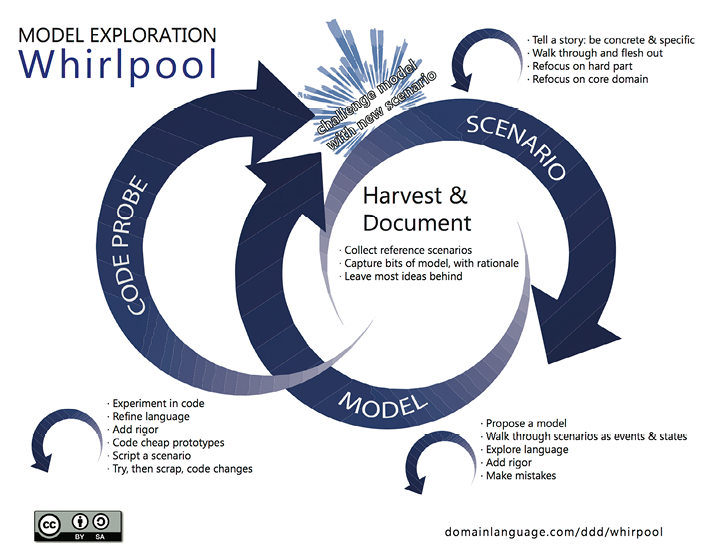
Use the Model Exploration Whirlpool to visualize collaborative modeling as interconnected feedback loops rather than a linear delivery path. section 11.3.1





























