A search engine that returns the same results for a repeated query cannot learn from what users do next. Continuous improvement turns those interactions into a feedback loop: collect signals, use them to adjust matching or ranking, and observe how later searches perform. This is also called reflected intelligence. section 1.3.2 section 1.4
A practical search loop has four stages:
- Return results for a query and record which results were displayed. section 4.2.1
- Collect subsequent signals, such as clicks, purchases, or explicit ratings. section 1.3.2 section 9.5
- Aggregate signals to learn relevance models that can boost results, personalize rankings, or improve query interpretation. section 4.2.1
- Deploy the updated model, measure improvements, and repeat as new interactions arrive. section 4.2.1 section 1.4
Learning from a product search
A user searches for “ipad,” clicks a displayed product, and purchases it. Logging the query, displayed results, click, and purchase lets the system combine this interaction with others. A learned model can then change future rankings—for example, by boosting popular results for that query. section 4.2.1
The loop also applies to personalized search, where recent interactions can update a profile as interests change. Use that feedback with a light touch: aggressive personalization can hide useful results, while collecting past behavior raises privacy concerns. Keeping some unpersonalized results available and offering controls can limit those costs. In chatbot search, refinement can happen during a single conversation as users give real-time feedback on responses. section 9.5 section 15.4
Figure 4.2 The reflected intelligence process. A user issues a query, sees results, and takes a set of actions. Those actions (signals) are then processed to create learned relevance models that improve future searches.
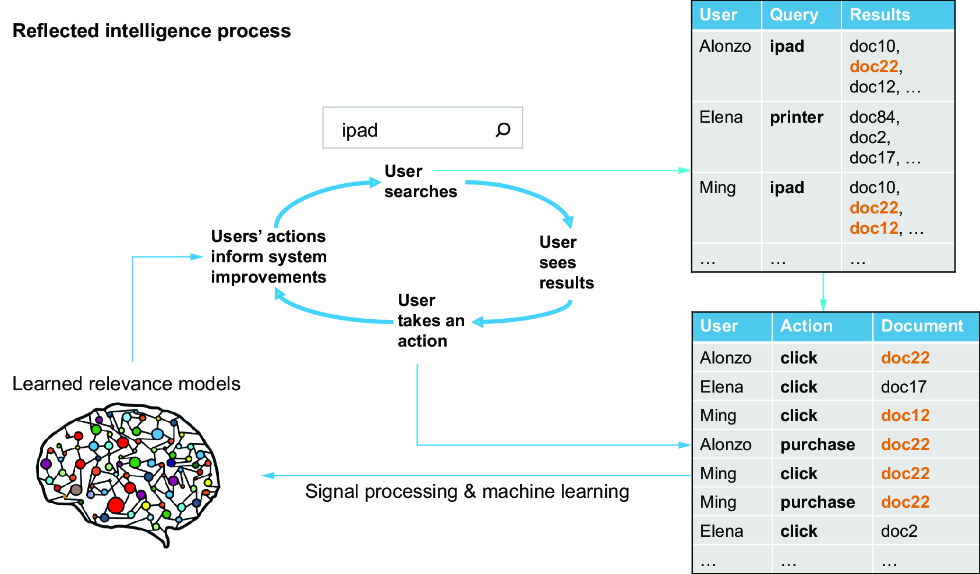
Follow the cycle from a query and displayed results through logged actions, a learned relevance model, and improved future searches. section 4.2.1





























