A threshold converts a model's fraud probability into a binary decision: output 1 when p > t and 0 when p <= t. Although 0.5 is a common default, the cutoff should reflect the application's precision and recall requirements. section 1.6.4
Use thresholds in progressively more deliberate ways:
- Sweep candidate values from 0 to 1, calculate precision and recall for each, and use the precision-recall curve to select an appropriate trade-off. section 1.6.4
- For a numerical rule, test distinct feature values, compare each resulting accuracy, and retain the best cutoff and comparison direction. section 2.2.2
- For deployment, choose a model threshold that satisfies a required precision while maximizing recall. section 3.7.5
A phishing URL rule
Testing NumDash values identifies 2 as the optimal threshold for the rule NumDash < 2, producing 67.76% accuracy. Combining this rule with another numerical-feature rule through OR or AND changes accuracy to 69.74% or 75.19%. section 2.2.2
Figure 1.22 Precision-recall curve with hypothetical threshold values pointing to two different sets of precision and recall values.
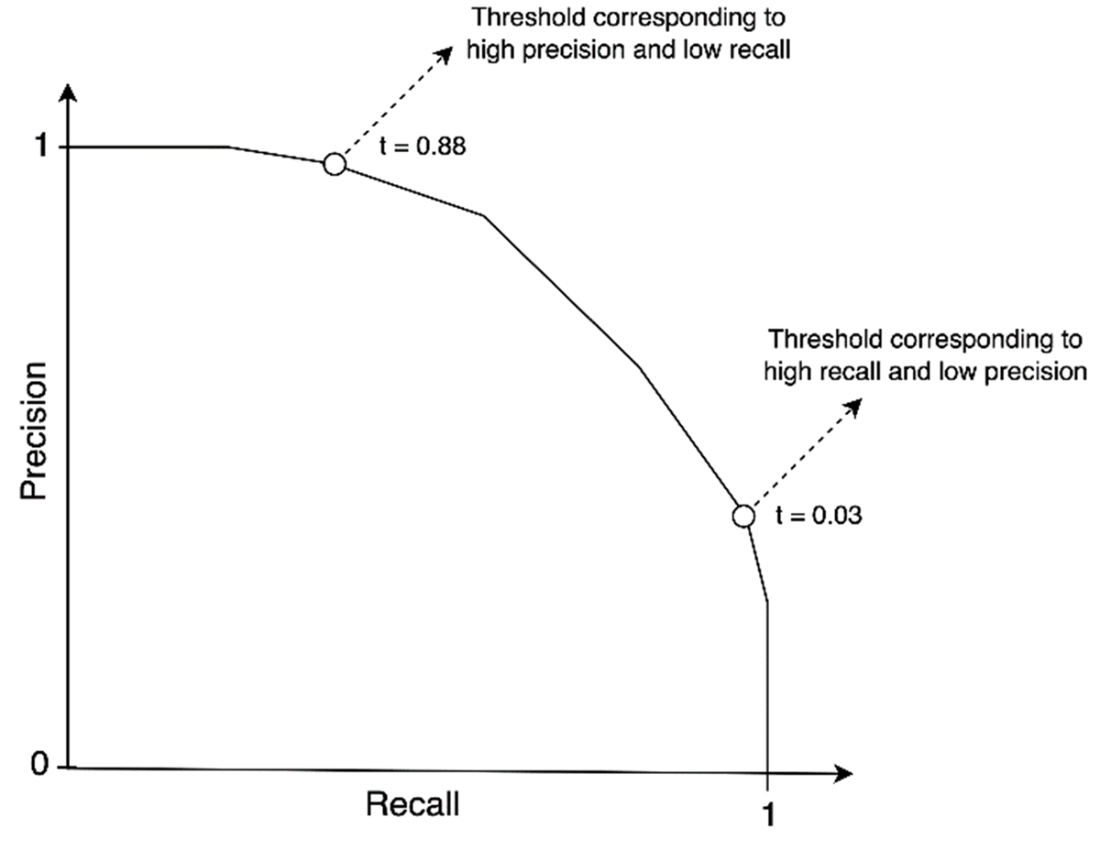
A precision-recall curve makes threshold choices visible by linking candidate cutoffs to their resulting precision and recall. section 1.6.4



















