Unsupervised learning finds patterns and relationships in input data without using a target variable to guide the result. It is useful when the goal is to explore a dataset’s structure, group similar observations, reduce dimensionality, or detect anomalies. Unlike supervised learning, it does not need a predefined outcome for each training example. section 1.5.2 section 1.7
Consider customer segmentation. A retailer can group customers using attributes such as revenue, visit frequency, last visit date, and demographics, then examine whether the groups suggest more relevant offers. The algorithm finds groupings; people still need to interpret whether those groupings are useful for the business decision. section 1.5.2 section 2.8
The approach includes several kinds of work:
- Clustering groups similar data points. Examples include k-means, hierarchical clustering, and DBSCAN; different grouping methods can produce different clusters. section 2.8 section 5.2
- Dimensionality reduction and feature learning seek useful representations of the data. Unsupervised feature-learning examples include matrix factorization, clustering, and autoencoders. section 1.7 section 9.2
- Anomaly detection looks for observations that stand apart from learned patterns, such as outliers in network-provider data. section 1.5.2
For an implementation, inspect and prepare the data before modeling, then examine the resulting groups or outliers against the original attributes and the decision at hand. Plots can help make the discovered structure visible. A cluster is an analytical result, not a target label the algorithm was given in advance. section 1.0 section 1.5.2
Figure 1.16 An unsupervised learning algorithm finds patterns in the data on the left and results in clusters on the right.
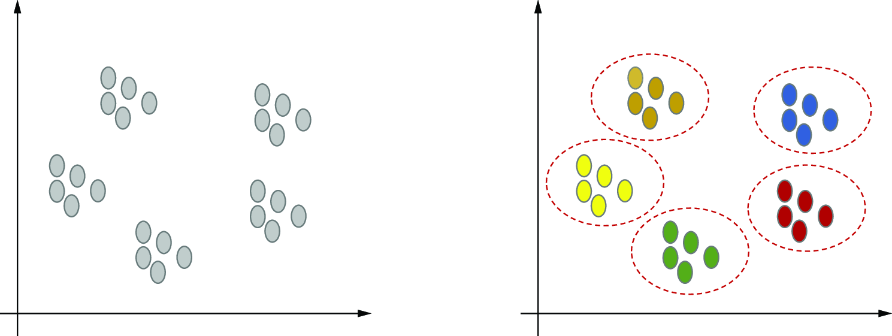
Compare the raw points with the resulting clusters to see the distinction between input data and a grouping discovered without target labels. section 1.5.2
The same principle applies to deep learning: training data is unlabeled, and a network must discover groupings or other representations rather than learn from supplied tags. For example, a supervised model might identify cats and dogs by label, while an unsupervised model might cluster their pictures. Autoencoders are one route to unsupervised feature learning; they are not the definition of unsupervised learning itself. section 8.5 section 9.2



















