Unsupervised learning trains a machine-learning algorithm on unlabeled data. It identifies underlying patterns and relationships without predefined labels, then organizes related data into clusters. section 22.3.1
Key distinctions:
- Uses unlabeled data, unlike supervised learning, which learns from labeled examples. section 22.3.1
- Finds structure and groups data into clusters, but does not assign human-readable labels automatically. section 22.3.1
- Supports analysis of network data to uncover patterns, anomalies, and insights. section 22.4
Cat-and-dog images
Given many unlabeled cat and dog photos, the algorithm groups images according to detected patterns. A human interprets the clusters and assigns labels such as “cat” or “dog.” section 22.3.1
Figure 22.12 Unsupervised machine learning. Unlabeled data is input into the ML algorithm, allowing it to identify patterns and relationships, categorizing the data into clusters. A human can then assign labels according to their interpretation of the grouped data.
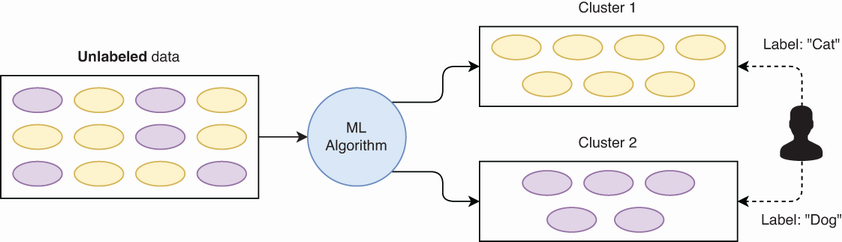
Use the diagram to distinguish unlabeled input, pattern identification, clustering, and subsequent human interpretation. section 22.3.1



















