Unsupervised learning finds useful structure in data without a target label to predict. It can reveal which items are similar, simplify complex data, or generate new examples that resemble existing ones. section 2.10 section 2.17
A dataset is unlabeled when it has no particular column designated for prediction; whether a feature counts as a label depends on the problem. Unlabeled pet images, for example, do not identify each image as a dog or cat, but an algorithm can still compare and group them. section 2.6 section 2.10
The main branches use unlabeled data in different ways:
- Clustering groups similar data points into clusters, such as houses grouped by location, price, or size. section 2.11
- Dimensionality reduction describes data with fewer features while trying to lose as little information as possible. section 2.10 section 2.17
- Generative learning creates new data points resembling the dataset, including realistic faces, music, or poetry. section 2.10 section 2.17
Grouping emails without labels
Suppose nine emails are recorded only by size and recipient count. Plotting those two features reveals three natural groups. A clustering algorithm can form the groups; people can then label them as Personal, Social, or Promotions. The same approach can use message words, senders, attachments, or links. section 2.11
Figure 2.4 An unsupervised learning algorithm can still extract information from data. For example, it can group similar elements together.
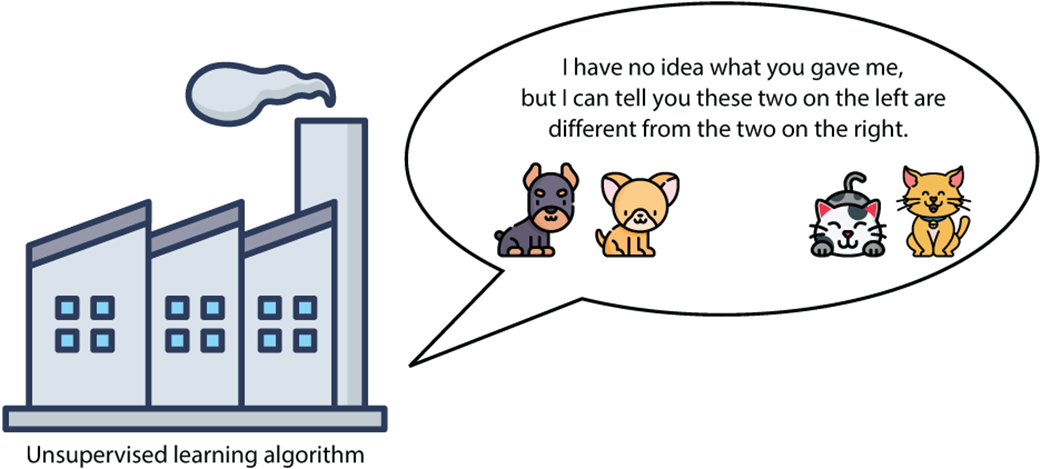
Shows how an unsupervised algorithm groups similar elements even when the groups have no known names. section 2.10





















