Unsupervised learning finds patterns in data without target labels to predict. It can reveal structure in unlabeled data, even when the groups it finds have no known meaning. section 2.3
Grouping without labels
A collection of cat and dog images has no labels, so a model cannot predict which pet a new image shows. It can still group similar images, perhaps separating cats from dogs or grouping them by breed. section 2.3
Common branches use patterns in different ways:
- Clustering groups similar data points, such as emails by size and number of recipients. section 2.3
- Dimensionality reduction simplifies data by describing it with fewer features while losing as little information as possible. section 2.3 section 2.5
- Generative learning creates new data points resembling existing data, such as realistic faces, music, or poetry. section 2.5
Unsupervised methods can also preprocess labeled data before supervised learning. They can simplify a dataset by grouping rows or reducing its features. section 2.3 section 2.5
Figure 2.1 Labeled data is data that comes with a tag, or label. That label can be a type or a number. Unlabeled data is data that comes with no tag. The dataset on the left is labeled, and the label is the type of pet (dog/cat). The dataset in the middle is also labeled, and the label is the weight of the pet (in pounds). The dataset on the right is unlabeled.
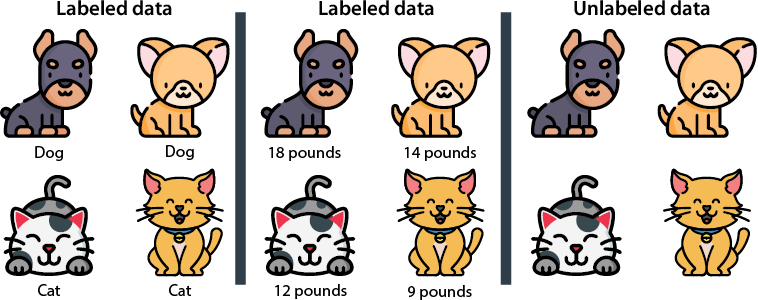
Compare labeled pet data with a dataset containing images but no labels. section 2.1



















