A deployment pipeline turns workflow code into a service external clients can call. It packages the code into containers, creates running replicas, registers API Gateway routes, monitors health, and scales for traffic. section 9.0
The pipeline connects decorator configuration to runtime behavior:
- Read the @workflow metadata. Scaling and resource settings configure container infrastructure; reliability and guardrails settings are enforced locally by the runtime server. section 9.1.1
- Build a container image for each workflow and set WORKFLOW_NAME so the runtime selects the matching decorated function. Multiple workflows in one Python module can deploy as separate images. section 9.1.2
- Create replicas and register routes so external HTTP requests reach the workflow runtime; the runtime uses gRPC for internal platform-service calls. section 9.1.2
Figure 9.1 Control plane vs. data plane. On the left, the Workflow Service (control plane) connects to Kubernetes to manage container Deployments and to the API Gateway to register routes. On the right, the data plane: multiple workflow containers, each running the SDK's runtime server, receiving HTTP requests from the API Gateway and making gRPC calls to platform services through the gateway. For synchronous and streaming workflows, the control plane and data plane do not communicate during request handling. For asynchronous workflows, the data plane calls the control plane to manage job state.
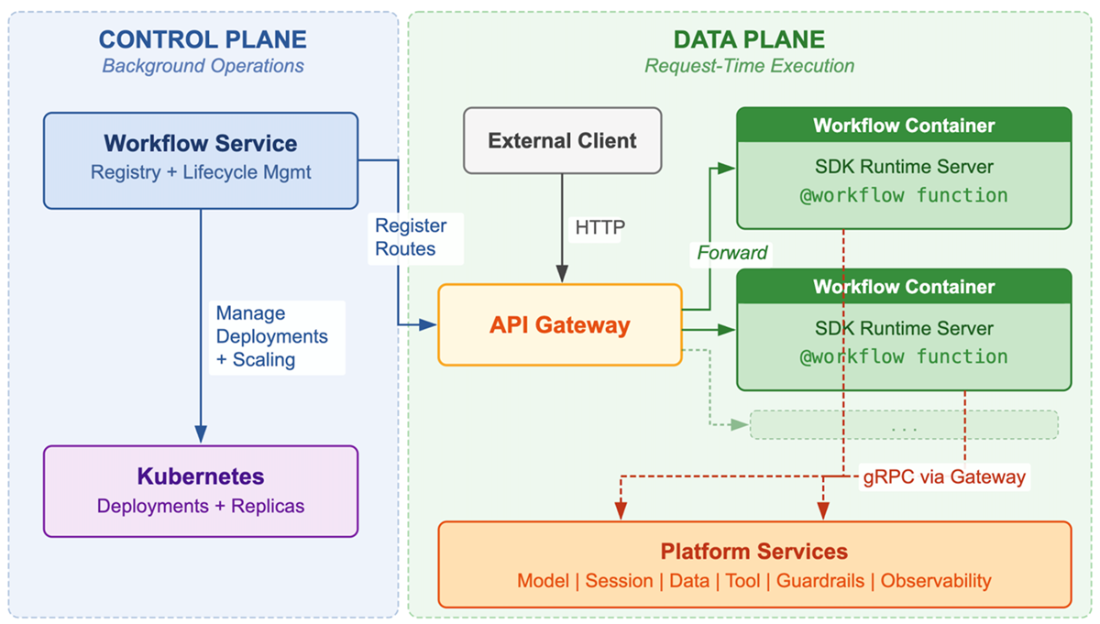
The control-plane and data-plane diagram shows how deployment management connects to Kubernetes and the API Gateway, while workflow containers handle requests. section 9.0