A deployment pipeline moves changes toward delivery or deployment through automated verification. For AI-generated code, a plausible diff is not evidence of correctness: an executable specification defines the rules, and the CI/CD pipeline enforces the checks that can be run mechanically. section 1.3 section 8.1.6
Automation catches only failures covered by its checks. Human review adds judgment about logic and intent; staging exposes integration and performance problems in context. Arrange gates to catch failures early, before production users bear the cost. section 8.1.6 section 8.8.4
Build a verification schedule around the risk of the change:
- On every change, run type checking, linting, static security analysis, core unit tests, and the CI test suite. section 8.8.4
- Before merge, review logic and intent and run integration tests for affected components. Add property testing, mutation testing, and security scanning regularly. section 8.8.4
- Before major releases, consider performance, chaos, and characterization testing. Invest more heavily in verification for security, financial, or safety-critical code. section 8.8.4 section 8.8.2
A 30-day refund policy
Turn “refunds within 30 days” into executable examples: an eligible refund succeeds, an expired request is rejected, and partial refunds cannot exceed the original amount. Add property tests around the 30-day boundary and make the pipeline run the resulting checks. A prototype can reveal rules and edge cases, but it is not the production verification gate. section 1.5
Figure 1.3 Each phase produces concrete, verifiable artifacts that all feed one executable specification, which the CI/CD pipeline enforces.
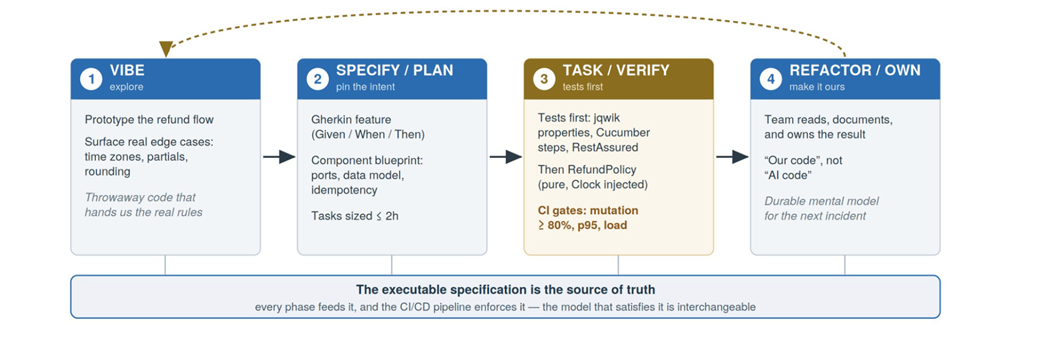
The diagram connects feature artifacts to an executable specification enforced by the CI/CD pipeline. section 1.5
CI-integrated agents can inspect pull-request diffs and test results for issues such as security concerns or missing coverage. Treat their findings as review aids, not independent proof: a judge model can share a generator model’s failure modes. Keep mechanical checks and human review in place. section 5.3.2