Regression predicts an exact numerical score from evaluation features. In COMET, it estimates translation quality from the source, candidate, and reference, then learns to match human ratings. section 3.3.2 section 3.3.3
A regression estimator follows this workflow:
- Collect examples with source text, candidate translation, reference translation, and absolute human scores. section 3.3.2
- Extract features describing source alignment, reference similarity, and differences between the translations. section 3.3.3
- Train the estimator by minimizing the difference between predicted scores and human ratings. section 3.3.2
- Use the trained model to output a numerical quality estimate, such as 78 or 78.5. section 3.3.2
Absolute translation-quality prediction
Given a source, candidate, and reference, an estimator can learn that similar combinations of features typically receive a score around 78. This suits DA ratings, MQM scores, and HTER values, where numerical supervision is available. section 3.3.2
Figure 3.13 Two flavors of COMET. Regression predicts exact scores; ranking learns relative quality by positioning better translations closer to anchors in embedding space.
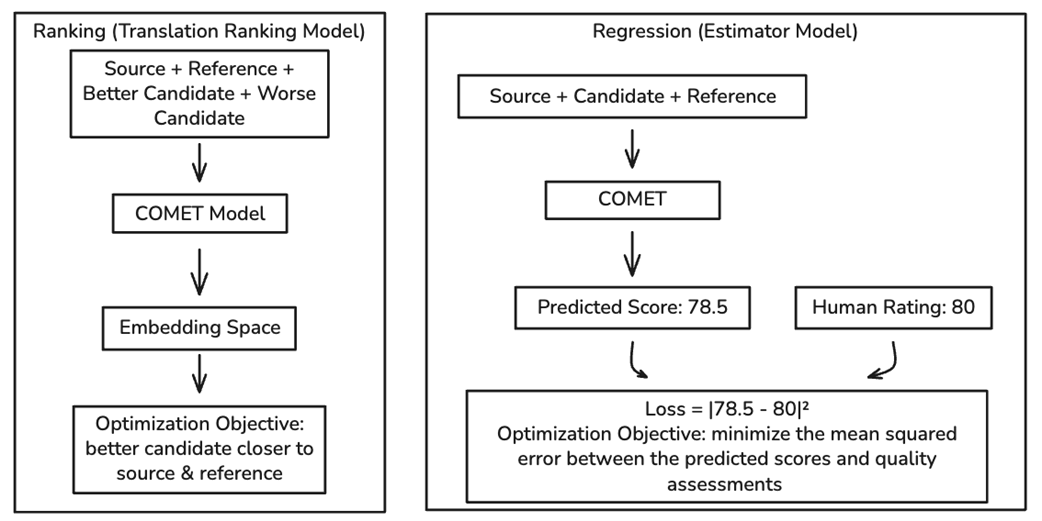
Compare exact-score regression with ranking, which learns relative quality instead of predicting an absolute value. section 3.3.2