The Model Context Protocol (MCP) is an open protocol for AI applications to discover and access tools, resources, and prompts exposed by external servers. It separates these capabilities from the agent harness, allowing an agent to connect to external context sources dynamically rather than hard-coding each integration. section 4.5 section 4.7
MCP does not replace the model-facing mechanism for tool use. Tool definitions guide the model’s choice of invocation; the agent harness executes the structured request, and the output can enter the working context. MCP standardizes how external capabilities are described, discovered, and accessed. section 4.5 section 1.5.3
MCP addresses a different boundary from other agent mechanisms:
- Function calling invokes predefined, schema-described capabilities; a CLI lets an agent run local executables through a shell. section 1.5.3
- Agent-to-agent (A2A) supports coordination and delegation between agents, while MCP connects agents to external tools and data. section 4.4
Bug investigation
An agent fetches a bug report with a predefined get_issue function, inspects recent changes using git diff through a shell tool, and reads project documentation exposed by an MCP server. The three mechanisms contribute different sources of context to the same investigation. section 1.5.3
External tool access needs operational controls. Depending on the action, these can include least-privilege permissions, argument validation, sandboxing, approval gates, and invocation tracing. section 4.7
Figure 4.4 The agent protocol stack: MCP for tools and external data, A2A for peer-agent collaboration, AG-UI for user-facing interaction, and ACP and LSP for development environments
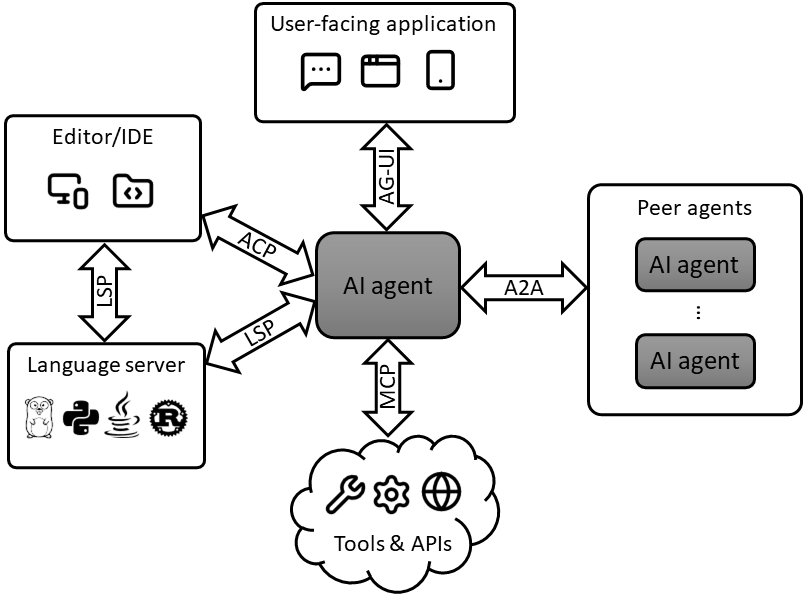
Locate MCP’s external-data boundary alongside protocols for peer agents, user interfaces, and development environments. section 4.4