The Model Context Protocol (MCP) is an open standard for connecting AI applications to servers that expose tools. It standardizes how tools advertise schemas, how calls are formatted, and how results return. A shared protocol replaces custom connectors between each application and each tool provider. section 6.4 section 6.4.4
Without a standard, five applications connecting to ten providers can require 50 integrations. With MCP, providers build standard wrappers and applications build standard connectors: 5 + 10 = 15 integrations. A shared Tool Service can reduce the organization's connection work further by connecting to each server once and sharing those connections across applications. section 6.4.1
Figure 6.8 The integration cost progression. Without a standard protocol (left), each AI application needs custom code for each external tool, creating a multiplicative and unscalable N × M cost. With the Model Context Protocol (center), the ecosystem standardizes, reducing the integration burden to an additive N + M requirement. By introducing a platform architecture (right), the Tool Service acts as the single, universal MCP client for all applications. This abstracts the complexity away from application developers entirely, reducing the organization's integration cost to just M: one connection per tool, securely shared across every application.
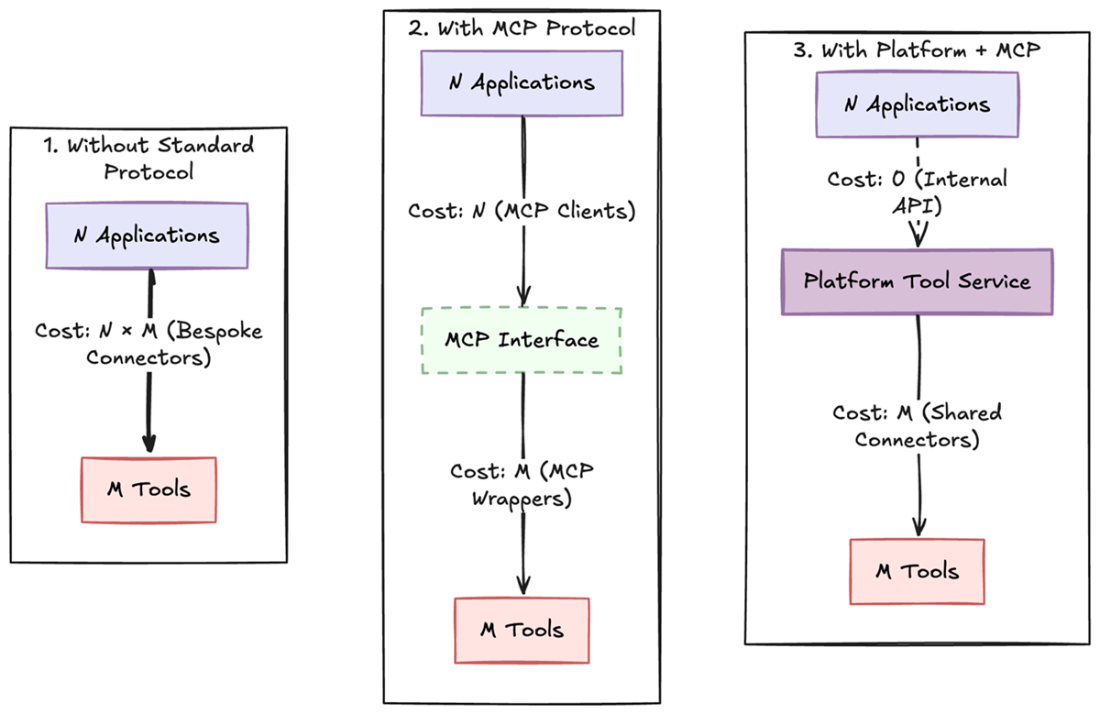
Compare the integration costs of bespoke connectors, protocol standardization, and a shared platform connector. section 6.4.1
MCP separates three roles:
- An MCP server wraps an external system and serves its capabilities. It may run locally as a subprocess or remotely as a service. section 6.4.2
- An MCP client connects to one server, discovers its tools, and routes invocation requests. A host uses a separate client for each server connection. section 6.4.2
- The host coordinates clients and the application interaction. A shared Tool Service can manage clients on behalf of multiple applications. section 6.4.2
A Tool Service can discover server tools, register them under a platform namespace, and route calls over MCP. Applications then use the same discovery and execution interface for MCP-backed tools and native adapters. Credential storage, policy enforcement, and invocation tracking remain platform responsibilities. section 6.4.5
Listing 6.16 Registering an external MCP server as a platform tool source
platform.tools.register_mcp_server(
    server_url="https://mcp-github.internal:3000/mcp",    #A
    namespace="devtools.github",    #B
    credential_ref="github-api-token",    #C
    policy_overrides={"requires_confirmation": True},
    rate_limit_overrides={"requests_per_minute": 30}    #D
)

tools = platform.tools.discover(
    namespace="devtools.github"
)    #E
# Returns: ["devtools.github.create_issue",
#           "devtools.github.list_repos", ...]
Register a GitHub MCP server with a namespace, credential reference, confirmation policy, and rate limit; then discover its tools. section 6.4.5
MCP does not replace production governance. Credential management for the wrapped system, policy enforcement, rate limits, audit trails, and version governance sit above the protocol. Verify community servers and account for risks such as prompt injection in tool descriptions, changed tool definitions after approval, and cross-server data exfiltration. Human approval depends on client-side enforcement. section 6.4.2 section 6.4.4
Web search in an agent loop
A web search tool can be registered through an MCP server and used alongside other managed tools in an agent loop. The search provider can be swapped for another MCP-compatible provider without changing the application code. section 10.6