A probability distribution assigns probabilities across possible values or configurations of a random system. In machine learning, it can describe the entire space of observed data and guide synthetic-data generation. section 10.3 section 8.8.2
Common machine-learning uses include:
- Modeling a data distribution lets generative models learn underlying patterns and produce new data resembling training examples. section 10.3
- Providing random input noise gives a GAN generator a seed for transforming simple samples into realistic synthetic data. section 10.4.1
- Comparing model and data distributions trains Boltzmann systems to lower energy and increase the likelihood of appropriate configurations. section 8.8.1 section 8.8.2
GAN generation
A generator samples a noise vector from a Gaussian or uniform distribution, transforms it through learned layers, and produces data intended to match the real data distribution. section 10.4.1
Figure 10.1 Representation of a GAN
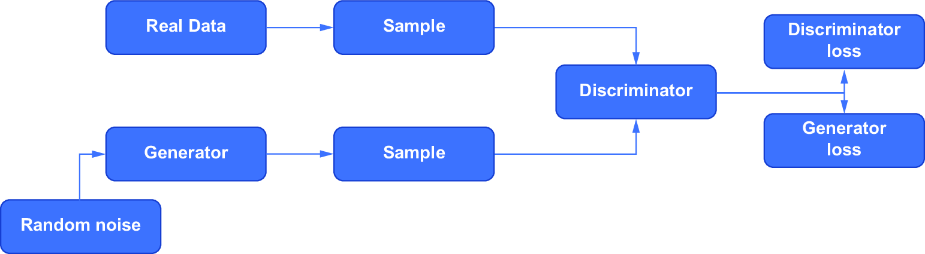
Use the GAN diagram to trace how sampled noise becomes generated data and how the generator targets the real data distribution. section 10.4.1


























