Performance is a measure of how well something achieves its goal. The meaning changes with context: it can describe a solution’s quality, an algorithm’s effectiveness, or the computational effort required. section 4.2
Use the meaning that matches the question:
- Measure computational efficiency by asking how quickly an algorithm runs as input grows. Big O notation describes this growth: O(1) stays roughly constant, O(n) grows with the input, and O(n²) grows much faster. section 2.2
- Measure solution fitness by asking how good the answer is for the problem. In a knapsack problem, a solution with greater total value has higher fitness, regardless of how long it took to find. section 4.2
- Measure a machine-learning model with evaluation metrics such as accuracy, while checking performance on unseen data rather than trusting training results alone. section 8.13
A knapsack decision
Suppose a knapsack has limited capacity and can hold valuable objects. Brute force checks every possible combination and selects the best valid one, but the number of combinations can become impractical as the dataset grows. An evolutionary algorithm may instead find an acceptable solution without guaranteeing the optimum. Comparing the solution’s value with the computation required separates fitness from computational efficiency. section 4.2
Figure 2.3 Big O complexity
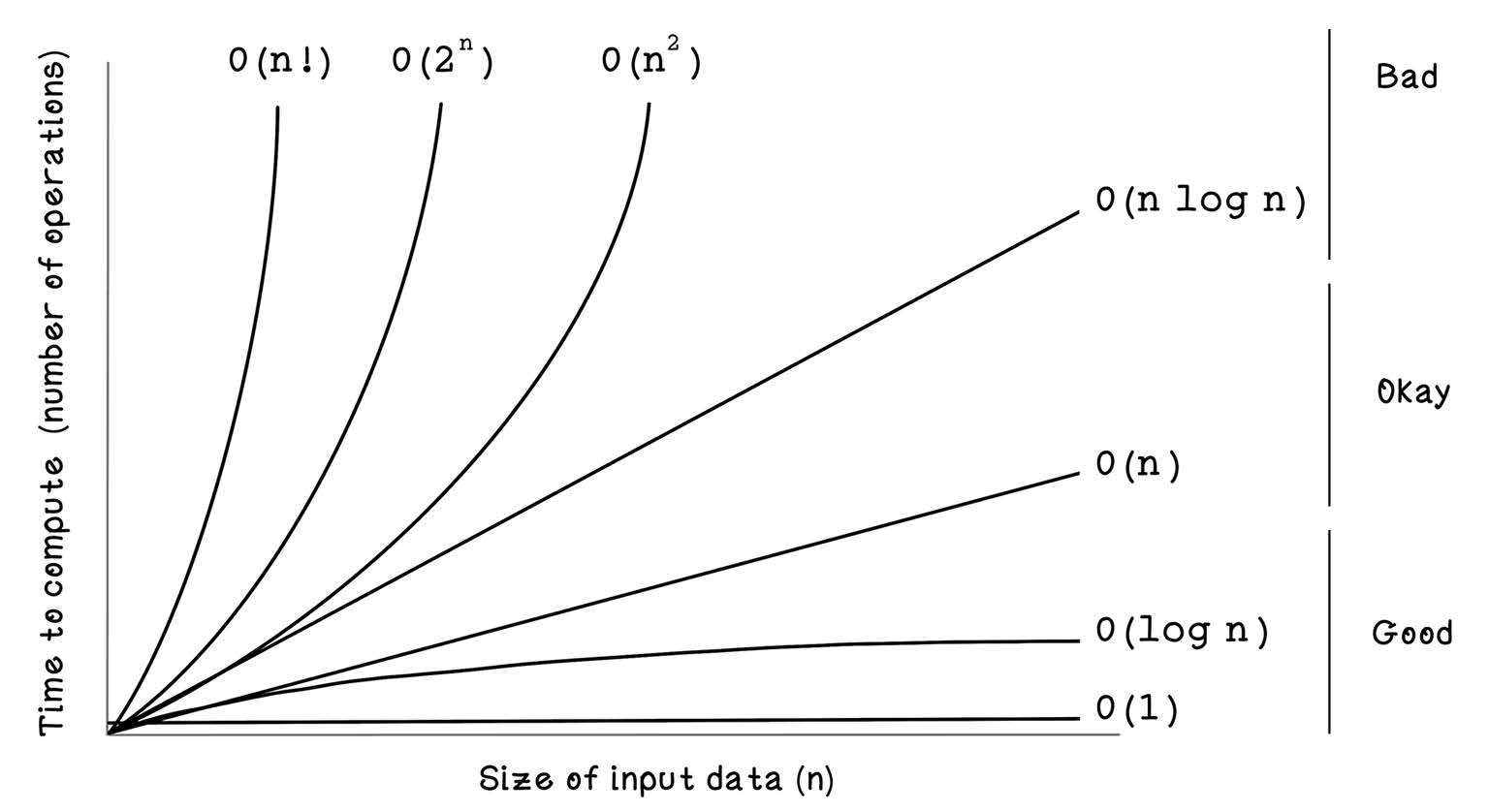
Compare how constant, linear, and quadratic computation costs grow as the input becomes larger. section 2.2







































