A pipeline is an ordered sequence of work that produces an outcome. In AI products, that work can run from preparing data through training, evaluation, and integration. A workflow may also loop: someone plans a task, uses tools, checks what happened, and adjusts the next step. section 12.1.2 section 9.0
A failure that starts upstream
A financial analytics team adds a conversational interface to a crowded dashboard. Its prototype performs well on test data but fails on real customer questions. The problem began when training data was assembled without input from users. The team interviews users, builds a test suite of real question-answer pairs, and narrows the interface toward questions the model can handle. Later, unexpected and malicious requests still require guardrails. A pipeline succeeds only when its upstream choices hold up in the end-user experience. section 1.1
The steps depend on what the pipeline is meant to accomplish:
- For data, preprocess, clean, and structure inputs so they can be used in training or inference; monitor quality and manage access. section 12.1.2
- For a complex language-model task, run one prompt per subtask and pass earlier results forward as context. This is prompt chaining, not a guarantee of accuracy. section 6.3.1
- For a manual workflow, a person plans, operates tools, and remembers each step. An LM agent may take on those activities after receiving a task, but full workflow automation still faces feasibility limits. section 9.0
Figure 9.1 Comparing a human workflow with an LM agent
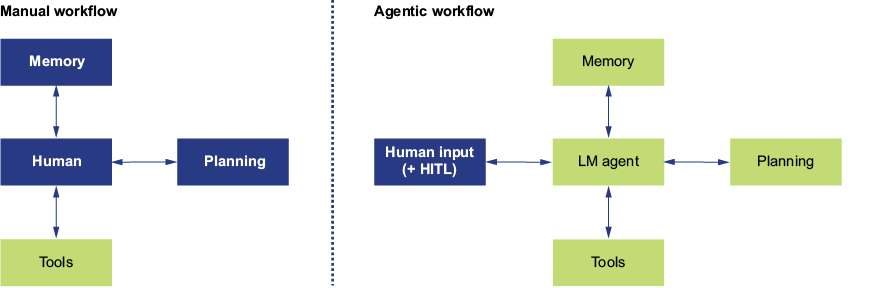
Compare where planning, tool use, and step tracking sit in a human-operated workflow versus an LM-agent workflow. section 9.0
Before automating a pipeline, identify its users, inputs, handoffs, and checks. Engineers can make the steps run; user research and real-world evaluation help determine whether those steps produce something useful and trustworthy. section 1.1 section 12.1.2















































