A data pipeline moves graph data from a raw state through exploration, transformation, and preprocessing until it can support GNN computation or training. The overall pattern is reusable, but each implementation depends on the data, storage choices, processing tools, and model. section 8.3 section 8.5
A practical graph-data pipeline commonly combines these operations:
- Inspect raw data with exploratory analysis and visualization, using graph statistics such as node count, edge count, and connected components. section 8.5
- Represent relationships as edge lists, adjacency lists, or adjacency matrices, selecting a consistent format for later processing. section 8.3 section 8.5
- Serialize data when it must be stored or exported, then create PyG data objects with attributes and masks for training, validation, and testing. section 8.3 section 8.5
From graph files to GNN-ready data
Load an edge list or adjacency structure into NetworkX for light analysis and visualization, convert the result into a PyG data object, and use masks to separate training, validation, and testing subsets. section 8.5
Figure 8.7 Summary of steps in the data pipeline process in this section
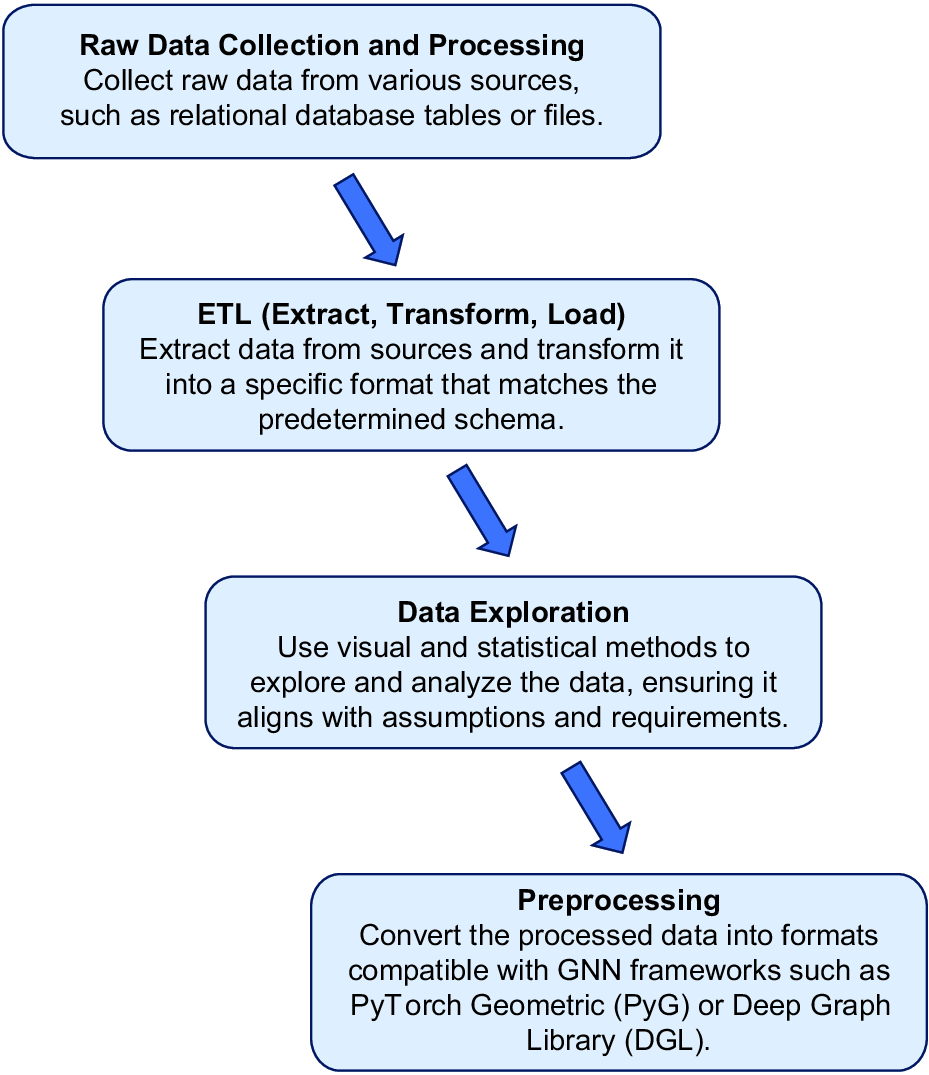
Use the pipeline summary to navigate the progression from raw data to a preprocessed dataset suitable for a GNN. section 8.3















































