A pipeline is a workflow in which distinct processing stages run in sequence, passing each stage’s output to the next. In drug discovery, this architecture turns a large compound library into a smaller set for increasingly demanding analysis. section 2.1.1 section 13.2.3
A pharmaceutical screening pipeline commonly proceeds from inexpensive broad filters toward specialized computational methods:
- Filter compounds for drug-likeness, structural alerts, lead-likeness, or desired ADMET properties. section 2.1.1
- Apply ligand-based screening, such as pharmacophore-based or machine-learning-based screening, to prioritize candidates. section 2.1.1
- Use molecular docking and then molecular dynamics simulations when candidates and computational resources justify the added cost. section 2.1.1
The pattern also connects different discovery platforms. Target-discovery outputs can feed molecular generation, whose candidate molecules then support later clinical-trial design. Each handoff makes the preceding stage’s ranking or validation important to downstream decisions. section 13.2.3
Antimalarial virtual screening
A practical pipeline starts with a chemical library and aims to produce a small set of compounds with promising antimalarial activity. If both positive and negative examples exist, machine learning can support ligand-based screening; with only positive examples, search-based strategies are more appropriate. section 2.1
Figure 2.1 Virtual screening pipelines are often hierarchical, proceeding with a broad, large number of compounds through simpler, less restrictive, and computationally cheaper processes to whittle down the quantity of compounds. If the 3D structure of the target is not defined, we’re restricted to ligand-based virtual screening. If it is defined, then we can explore structure-based virtual screening, potentially as a downstream component to ligand-based virtual screening.
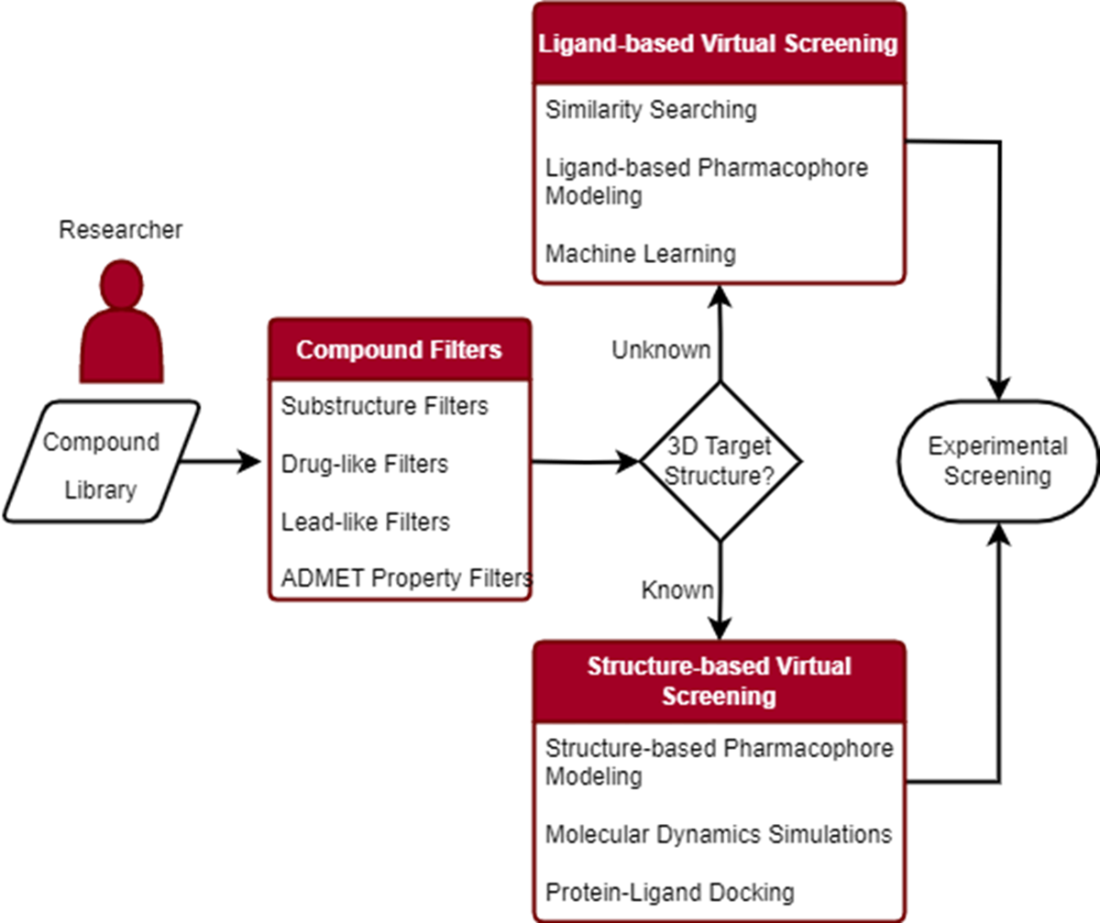
Use the workflow figure to compare ligand-based and structure-based branches, and to see how cheaper upstream stages narrow the set before downstream computation. section 2.1.1






























































